
U.S. Customs and Border Protection – Travel Information for International Visitors
|
|||||||||||||||||||||||||||||||||||||||||||||||||||||||||||||||||||||||||||||||||||


 pdf – 23 KB.
Global Entry Program
- Boston-Logan International Airport (BOS)
- Chicago O’Hare International Airport (ORD)
- Dallas/Ft. Worth International Airport (DFW)
- Detroit Metropolitan Airport (DTW)
- Ft. Lauderdale Hollywood International Airport (FLL)
- George Bush Intercontinental Airport, Houston (IAH)
- Hartsfield-Jackson Atlanta International Airport (ATL)
- Honolulu International Airport (HNL)
- John F. Kennedy International Airport (JFK)
- McCarran International Airport, Las Vegas (LAS)
- Los Angeles International Airport (LAX)
- Miami International Airport (MIA)
- Newark Liberty International Airport (EWR)
- Orlando International Airport (MCO)
- Philadelphia International Airport (PHL)
- San Francisco International Airport (SFO)
- San Juan-Luis Múñoz Marin International Airport (SJU)
- Orlando-Sanford International Airport (SFB)
- Seattle-Tacoma International Airport-SeaTac (SEA)
- Washington-Dulles International Airport (IAD)
The process requires participants to present their machine-readable U.S. passport or permanent resident card, submit their fingerprints for biometric verification, and make a customs declaration at the kiosk’s touch-screen. Upon successful completion of the Global Entry process at the kiosk, the traveler is issued a transaction receipt and directed to baggage claim and the exit, unless chosen for a selective or random secondary referral.
Travelers must be pre-approved before they can participate in the pilot program. All applicants will undergo a rigorous background check and be interviewed by a CBP officer before they are enrolled. Automated enforcement checks will occur each time the member uses the kiosk to enter the United States. Although pre-approved for the program and determined to be low risk, members of Global Entry may be examined at any time when entering the United States.
Members entering the United States must complete the declaration questions prompted by the kiosk. If bringing items that must be declared, after completion of the kiosk transaction, the member will be directed to see a CBP officer.
Global Entry has a zero tolerance policy for violations. If a Global Entry member violates any of the terms and conditions, CBP officers will take appropriate enforcement action and will cancel the person’s membership privileges. The application fee is non-refundable.
What Are the Benefits of Global Entry?
The benefits are:
- Bypass the traditional passport control line.
- No more filling out a paper customs declaration form.
- Expedited exit process.
- Mutual benefits with other countries.
- Conveniently located at airports throughout the country.
- Cross the border with a minimum of customs and immigration questioning.
- Although this program is intended for frequent travelers, there is no minimum number of trips that must be completed.
Global Entry allows applicants to complete a single application and pay one fee. This form can be submitted online via the Global Online Enrollment System (GOES. Qualified applicants are required to come to a Global Entry Enrollment Center, for an interview). Global Entry allows United States border agencies to concentrate their efforts on potentially higher-risk travelers and goods, which helps to ensure the security and integrity of our borders.
Who May Apply for Global Entry?
- Individuals who are 14 years of age and older who are U.S. citizens, U.S. nationals, U.S. Lawful Permanent Residents, or citizens of certain other countries.
*Note: If enrolled parents are traveling with children under 14 and clearing as a family, they may not use the kiosk and must clear using the regular passport control process.
However, individuals may not qualify if they:
- Are inadmissible to the United States under applicable immigration laws;
- Provide false or incomplete information on their application;
- Have been convicted of a criminal offense in any country;
- Have been found in violation of customs or immigration laws; or
- Fail to meet other Global Entry requirements.
If an individual does not meet the requirements of Global Entry, their application will be denied.
Fee
Applications must be completed and submitted online through the Global Online Enrollment System (GOES). ( GOES ) A non-refundable $100 fee will be collected before the submission of the application. If an applicant is denied participation, he/she will not receive a refund of the $100. NEXUS and SENTRI members may activate membership in Global Entry at no additional fee.
Inquiries
Applicants who are not accepted into the Global Entry pilot have three channels for forwarding their inquiries: a) directly with the enrollment center; b) DHS Travelers Redress Inquiry Program (DHS TRIP); and c) the CBP Trusted Traveler Ombudsman. Please see the DHS Traveler Redress Inquiry Program page for more information on how to seek redress. (DHS Traveler Redress Inquiry Program )
Consistent with privacy law and national security considerations, DHS and CBP may not reveal the specific reason for an applicant’s denial in either the initial notification or the redress process depending on the circumstances of a particular case.
|
||||||||||||||||||||||||||||||||||||||||||||||||


 pdf – 3,086 KB.
DHS Traveler Redress Inquiry Program (DHS TRIP)
DHS Traveler Redress Inquiry Program (DHS TRIP)
 Get e-mail updates when this information changes
Learn more about redress numbers.
The Department of Homeland Security’s Travel Redress Inquiry Program (DHS TRIP) is a single point of contact for individuals who have inquiries or seek resolution regarding difficulties they experienced during their travel screening at transportation hubs–like airports and train stations–or crossing U.S. borders, including:
- denied or delayed airline boarding
- denied or delayed entry into and exit from the U.S. at a port of entry or border checkpoint
- continuously referred to additional (secondary) screening
Why DHS TRIP?
DHS TRIP is a central gateway to address
- watch list misidentification issues
- situations where travelers believe they have faced screening problems at ports of entry
- situations where travelers believe they have been unfairly or incorrectly delayed, denied boardin
g or identified for additional screening at our nation’s transportation hubs
DHS TRIP is part of an effort by the State Department and Homeland Security to welcome legitimate travelers while still securing our country from those who want to do us harm.
Who is DHS TRIP for?
People who have been repeatedly identified for additional screening can file an inquiry to have erroneous information corrected in DHS systems.
How does DHS TRIP work?
DHS TRIP is the central processing point for redress inquiries. Requests received online are routed for redress to the appropriate DHS components. Components will review the request and reach a determination about a traveler’s status.
How is the information used?
The Department of Homeland Security safeguards the privacy of any personal information that you provide in your inquiry to DHS TRIP. The information that you provide will be used to process your request for redress. More information on DHS TRIP and your privacy.
Getting started with DHS TRIP
Learn more about TRIP and make an inquiry online.
» Go to DHS TRIP
This page was last reviewed / modified on November 9, 2009.
Secretary Napolitano Issues Bold Efficiency Review Initiative
Via DHS.gov
Release Date: February 17, 2009
For Immediate Release
Office of the Press Secretary
Contact: 202-282-8010
U.S. Department of Homeland Security (DHS) Secretary Janet Napolitano announced today a department-wide action directive challenging every agency, component and office to generate new efficiencies and to promote greater accountability, transparency and customer satisfaction.
“Developing a leaner, smarter and more efficient DHS is a responsibility shared by all agencies, offices and employees across the department,” said Secretary Janet Napolitano. “Transforming DHS will require significant effort and input on everyone’s behalf. But through a unified and sustained effort, we will make lasting and meaningful improvements.”
An Efficiency Review Initiative Steering Committee, composed of key office and component leadership, will be established to coordinate this DHS-wide initiative. The Steering Committee, which will have its initial meeting before the end of the month, will identify and develop strategies to reduce costs, streamline processes, eliminate duplication and improve transparency and customer service.
The action directive requires each agency to initiate an internal review of current efforts related to improving efficiency, which will be incorporated into a department-wide inventory.
When she was Governor of Arizona, Napolitano oversaw a similar initiative resulting in more than $1 billion in savings and cost avoidances for the state government focused on procurement, energy conservation, travel, fleet management, training and electronic communications.
###
Resources for New Immigrants
Resources for New Immigrants

The United States has a long history of welcoming immigrants from all over the world. We value the contributions of immigrants, who continue to enrich this country and preserve its legacy as a land of freedom and opportunity. Though we are a nation of diverse cultures and backgrounds, we are bound by our shared history, the common civic values set forth in our founding documents, and the English language.
USCIS is committed to helping immigrants successfully integrate into American civic culture. Through the landmark publication Welcome to the United States: A Guide for New Immigrants, USCIS offers a comprehensive guide containing practical information to help immigrants settle into everyday life in the United States, as well as basic civics information that introduces new immigrants to the U.S. system of government. Welcome to the United States: A Guide for New Immigrants is available online in English, Spanish, Chinese, Arabic, French, Haitian Creole, Korean, Polish, Portuguese, Russian, Tagalog, Urdu, and Vietnamese. New permanent residents can request a free copy of the guide in English (Form M-618), Spanish (Form M-618-S), or Chinese (Form M-618-C) from the USCIS Forms Line by calling 1-800-870-3676.

Welcome to the United States is also available for purchase in English, Spanish, and Chinese through the U.S. Government Printing Office (GPO). To order a print version of this publication, follow the GPO link to the right or call 1-866-512-1800 (toll-free) or 202-512-1800 if you live in the Washington, DC metro area.
*This guide contains information on a variety of topics that are not within the jurisdiction of DHS/USCIS. If you have a question about a non DHS/USCIS issue, please refer directly to the responsible agency or organization for the most current information. The information in this guide is correct at the time of publication; however it may change in the future.
This page can be found at <a href="http://www.uscis.gov/newimmigrants
Welcome to the United States: A Guide for New Immigrants (English Version) (1595KB PDF)
Brochure – Welcome to the United States: A Guide for New Immigrants (English Version) (3419KB PDF)
Welcome to the United States: A Guide for New Immigrants (Arabic Version) (2229KB PDF)
Welcome to the United States: A Guide for New Immigrants (Chinese Version) (3626KB PDF)
Welcome to the United States: A Guide for New Immigrants (Haitian Creole Version) (2094KB PDF)
Welcome to the United States: A Guide for New Immigrants (Korean Version) (2227KB PDF)
Welcome to the United States: A Guide for New Immigrants (French Version) (2123KB PDF)
Welcome to the United States: A Guide for New Immigrants (Polish Version) (2289KB PDF)
Welcome to the United States: A Guide for New Immigrants (Portuguese Version) (3759KB PDF)
Welcome to the United States: A Guide for New Immigrants (Russian Version) (2602KB PDF)
Welcome to the United States: A Guide for New Immigrants (Spanish Version) (1682KB PDF)
Welcome to the United States: A Guide for New Immigrants (Tagalog Version) (2615KB PDF)
Welcome to the United States: A Guide for New Immigrants (Urdu Version) (2188KB PDF)
Welcome to the United States: A Guide for New Immigrants (Vietnamese Version) (2284KB PDF)
Immigration Statistics 2007 – Via the Department of Homeland Security
Immigration Enforcement Actions: 2007 (PDF – 4 pages – 181.99 KB)
This report presents information on the apprehension, detention, return
and removal of foreign nationals during fiscal year 2007.
Estimates of the Unauthorized Immigrant Population Residing in the United States: January 2007 (PDF – 7 pages – 258 KB)
This report provides estimates of the unauthorized immigrant population
residing in the United States as of January 2007 for periods of entry
and leading countries of birth and states of residence.
Nonimmigrant Admissions to the United States: 2007 (PDF, 10 pages – 297 KB)
This report examines the number and characteristics of nonimmigrant admissions in fiscal year 2007.
Data on Nonimmigrant Admissions.
Access data on nonimmigrant admissions by class, country, and other characteristics for fiscal year 2007.
Refugees and Asylees: 2007 (PDF, 6 pages – 413 KB)
This report presents information on the number and characteristics of
persons admitted as refugees or granted asylum to the United States in
fiscal year 2007.
Data on Refugees and Asylees.
Access data on persons admitted as refugees or granted asylum in fiscal year 2007 by several characteristics.
Yearbook of Immigration Statistics
2007 Yearbook of Immigration Statistics
The Yearbook is a compendium of tables that
provides data on foreign nationals who, during fiscal year 2007, were
granted lawful permanent residence, were admitted into the United
States on a temporary basis, applied for asylum or refugee status, or
were naturalized. The Yearbook also presents data on immigration law enforcement actions.
Janet Napolitano was sworn in on January 21, 2009 as the third Secretary of the Department of Homeland Security.
VIA DHS.gov
Secretary Janet Napolitano
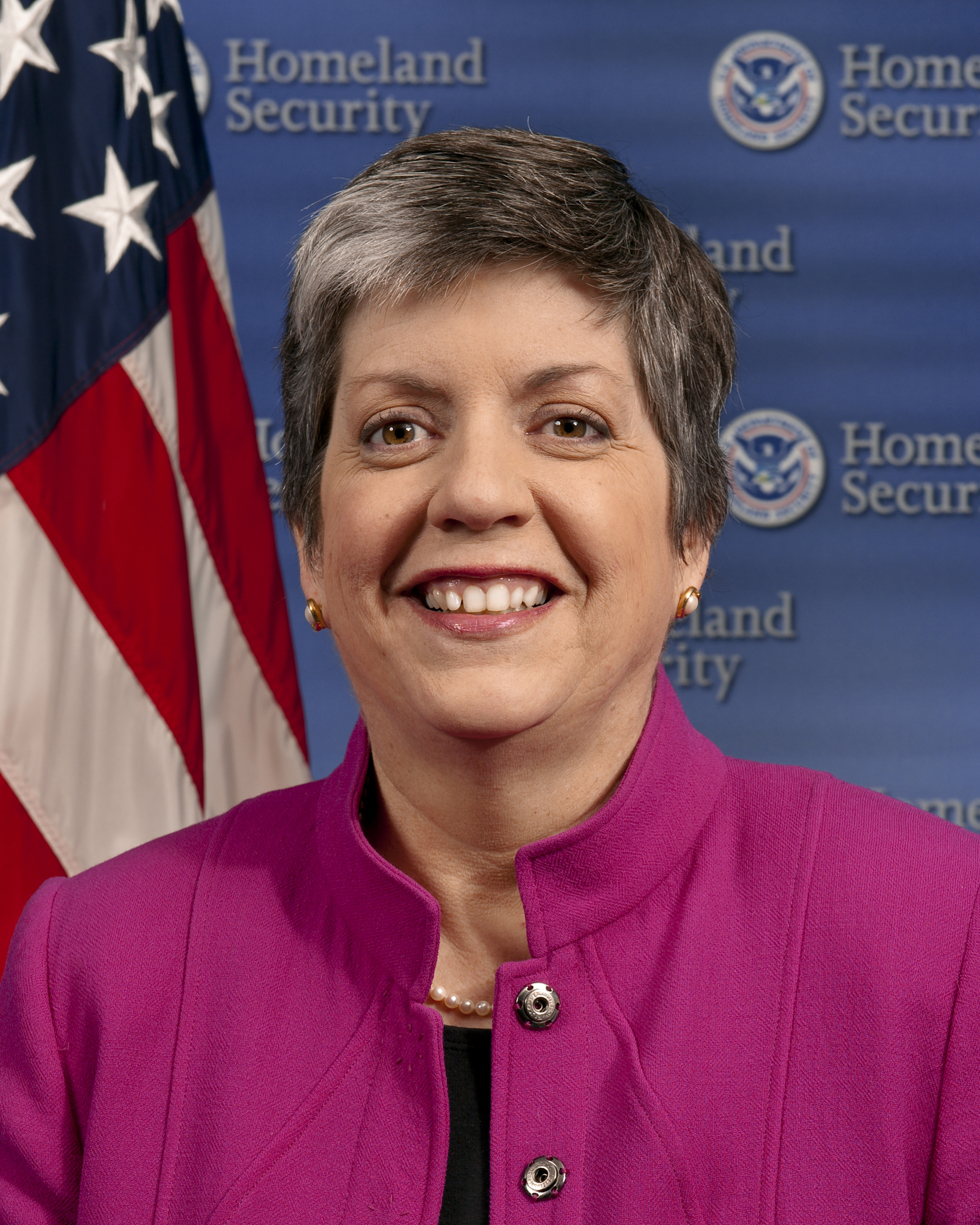
Janet
Napolitano was sworn in on January 21, 2009 as the third Secretary of
the Department of Homeland Security. Prior to joining the Obama
Administration, Napolitano was mid-way through her second term as
Governor of the State of Arizona. While Governor, Napolitano became the
first woman to chair the National Governors Association, where she was
instrumental in creating the Public Safety Task Force and the Homeland
Security Advisors Council. She also chaired the Western Governors
Association. Napolitano previously served as the Attorney General of
Arizona and the U.S. Attorney for the District of Arizona.
Napolitano’s homeland security background is extensive. As U.S.
Attorney, she helped lead the domestic terrorism investigation into the
Oklahoma City Bombing. As Arizona Attorney General, she helped write
the law to break up human smuggling rings. As Governor, she implemented
one of the first state homeland security strategies in the nation,
opened the first state counter-terrorism center and spearheaded efforts
to transform immigration enforcement. She’s also been a pioneer in
coordinating federal, state, local and bi-national homeland security
efforts, and presided over large scale disaster relief efforts and
readiness exercises to ensure well-crafted and functional emergency
plans.
Napolitano graduated from Santa Clara University in 1979, where she
won a Truman Scholarship, and received her Juris Doctor (J.D.) in 1983
from the University of Virginia School of Law. After law school she
served as a law clerk for Judge Mary M. Schroeder of the U.S. Court of
Appeals for the Ninth Circuit before joining the law firm of Lewis and
Roca.
The New Naturalization Test: Questions and Answers from the CIS Ombudsman’s E-mails
1. The new test indicates that people who live in the US for
20 or more years and who are 70 or older are eligible to take the
naturalization test with 20 questions in lieu of 100. Our question is:
In what language? English or native language.
Response from USCIS: The new naturalization test did not change the
regulations that allow exemptions for testing based on age and time as
a permanent resident.
An applicant qualifies to take a modified civics test if on the date
of filing the application, the applicant was 65 years old and has been
a lawful permanent resident for at least 20 years. If this exception
applies, the applicant will be administered a simpler version of the
civics examination in the applicant’s language of choice. This modified
civics test is a sample of 20 civics questions from the list of 100.
The sample civics questions have been identified for applicants qualifying under this exception and will soon be announced.
2. After October 1, 2008 when the new test becomes
effective, will the current rule “English Exemption for people 55 or
older and resident in the US for 15 or more years” be still applicable?
Response from USCIS: Currently the people who meet these
requirements are eligible to take the naturalization test in their
native language. The new naturalization test did not change the
regulations that allow exemptions for testing based on age and time as
a permanent resident.
The English language requirement may be waived for an applicant who
on the date of filing the application, was over 50 years old and has
been lawful permanent resident for at least 20 years, or was over 55
years old and has been a lawful permanent resident for at least 15
years. If either exception applies, the applicant may take the civics
examination in the applicant’s language of choice.
Further, an applicant qualifies to take a modified civics test if on
the date of filing the application, the applicant was 65 years old and
has been a lawful permanent resident for at least 20 years. If this
exception applies, the applicant will be administered a simpler version
of the civics examination in the applicant’s language of choice. This
modified civics test is a sample of 20 civics questions from the list
of 100. The sample civics questions have been identified for applicants
qualifying under this exception and will soon be announced.
If applicants qualify for a waiver of the English proficiency
requirement, they must bring an interpreter to their naturalization
interview.
3. The new test has a list of reading vocabulary and
a list of writing vocabulary. Please explain how the reading and
writing test will be administered? Will the applicants be required to
make sentences using the vocabulary on the list?
Response from USCIS: The format for the reading portion of the
redesigned English test is similar to the current test. Applicants
will be provided with up to three chances to correctly read a sentence
in English. USCIS has released a vocabulary list containing all of the
words found in the redesigned test items. The content items for the
reading portion focus on civics and history topics.
The format for the writing portion of the redesigned writing test is
also similar to the current test. Applicants will be provided with up
to three chances to correctly write a sentence dictated by the
adjudications officer in English. USCIS has released a vocabulary list
containing all the words found in the redesigned writing test. The
content items for the writing portion also focus on civics and history
topics.
USCIS has posted the reading and writing vocabulary for the new test on http://www.uscis.gov/newtest.
DHS Publishes Final Rule Expanding US-VISIT to Include LPRs
[Rules and Regulations]
[Page 77473-77491]
From the Federal Register Online via GPO Access [wais.access.gpo.gov]
[DOCID:fr19de08-1]
—————————————
Rules and Regulations
Federal Register
—————————————
This section of the FEDERAL REGISTER contains regulatory documents having general applicability and legal effect, most of which are keyed to and codified in the Code of Federal Regulations, which is published under 50 titles pursuant to 44 U.S.C. 1510.
The Code of Federal Regulations is sold by the Superintendent of Documents. Prices of new books are listed in the first FEDERAL REGISTER issue of each week.
—————————————
[[Page 77473]]
DEPARTMENT OF HOMELAND SECURITY
8 CFR Parts 215 and 235
[DHS-2005-0037]
RIN 1601-AA35; RIN 1600-AA00
United States Visitor and Immigrant Status Indicator Technology Program (“US-VISIT”); Enrollment of Additional Aliens in US-VISIT; Authority To Collect Biometric Data From Additional Travelers and Expansion to the 50 Most Highly Trafficked Land Border Ports of Entry
AGENCY: National Protection and Programs Directorate, DHS.
ACTION: Final rule.
—————————————
SUMMARY: The Department of Homeland Security (DHS) established the United States Visitor and Immigrant Status Indicator Technology Program (US-VISIT) in 2003 to verify the identities and travel documents of aliens. Aliens subject to US-VISIT may be required to provide fingerscans, photographs, or other biometric identifiers upon arrival at the United States. Currently, aliens arriving at a United States port of entry with a nonimmigrant visa, or those traveling without a visa as part of the Visa Waiver Program, are subject to US-VISIT requirements with certain limited exceptions. This final rule expands the population of aliens who will be subject to US-VISIT requirements to nearly all aliens, including lawful permanent residents. Exceptions include Canadian citizens seeking short-term admission for business or pleasure under B visas and individuals traveling on A and G visas, among others.
Yearbook of Immigration Statistics: 2007
VIA DHS
Immigrants
| Table # | Title |
|---|---|
| Table 1 | Persons Obtaining Legal Permanent Resident Status: Fiscal Years 1820 to 2007 (XLS, 19 KB) |
| Table 2 | Persons Obtaining Legal Permanent Resident Status by Region and Selected Country of Last Residence: Fiscal Years 1820 to 2007 (XLS, 43 KB) |
| Table 3 | Persons Obtaining Legal Permanent Resident Status by Region and Country of Birth: Fiscal Years 1998 to 2007 (XLS, 47 KB) |
| Table 4 | Persons Obtaining Legal Permanent Resident Status by State of Residence: Fiscal Years 1998 to 2007 (XLS, 29 KB) |
| Table 5 | Persons Obtaining Legal Permanent Resident Status by Core Based Statistical Area (CBSA) of Residence: Fiscal Years 1998 to 2007 (XLS, 22 KB) |
| Table 6 | Persons Obtaining Legal Permanent Resident Status by Type and Major Class of Admission: Fiscal Years 1998 to 2007 (XLS, 24 KB) |
| Table 7 | Persons Obtaining Legal Permanent Resident Status by Type and Detailed Class of Admission: Fiscal Year 2007 (XLS, 63 KB) |
| Table 8 | Persons Obtaining Legal Permanent Resident Status by Gender, Age, Marital Status, and Occupation: Fiscal Year 2007 (XLS, 19 KB) |
| Table 9 | Persons Obtaining Legal Permanent Resident Status by Broad Class of Admission and Selected Demographic Characteristics: Fiscal Year 2007 (XLS, 20 KB) |
| Table 10 | Persons Obtaining Legal Permanent Resident Status by Broad Class of Admission and Region and Country of Birth: Fiscal Year 2007 (XLS, 37 KB) |
| Table 11 | Persons Obtaining Legal Permanent Resident Status by Broad Class of Admission and Region and Country of Last Residence: Fiscal Year 2007 (XLS, 37 KB) |
| Table 12 | Immigrant Orphans Adopted by U.S. Citizens by Gender, Age, and Region and Country of Birth: Fiscal Year 2007 (XLS, 21 KB) |
 The U.S. Immigration Law Blog by Ashwin Sharma
The Closing of the American Border: Terrorism, Immigration and Security Since 9/11: A book written by Edward Alden, Former Washington bureau chief of the Financial Times
09/17/2008
A book written by Edward Alden,
Former Washington bureau chief of the Financial Times was published yesterday by HarperCollins. It will be of great interest
to readers of this blog. The book is entitled The Closing of the American
Border: Terrorism, Immigration and Security Since 9/11. It tells the
story of the internal battles within the Bush administration after 9/11
over how far to go in tightening U.S. borders in what was often a misguided
effort to keep out terrorists. That story is interspersed with many personal
tales of innocent people who got caught up in the labryinth of post-9/11
restrictions. Mr. Alden also makes a number of larger points about the damage that
has been done to the U.S. economy and to the country’s standing in the
world by the heavy-handed way in which border security measures have been
implemented.
The book comes out of reporting the author did
after 9/11 while he was the Washington Bureau Chief for the Financial Times,
and well as more than a year of further research after he joined the Council
on Foreign Relations.
The book is available in bookstores,
and on Amazon at http://www.amazon.com/Closing-American-Border-Terrorism-Immigration/dp/0061558397/ref=sr_1_2?ie=UTF8&s=books&qid=1221575965&sr=1-2
You can also get a preview of some of
the chapters at: http://browseinside.harpercollins.com/index.aspx?isbn13=9780061558399
Product Description from Amazon.com
“On September 10, 2001, the United States was the most open country
in the world. But in the aftermath of the worst terrorist attacks on
American soil, the U.S. government began to close its borders in an
effort to fight terrorism. The Bush administration’s goal was to build
new lines of defense against terrorists without stifling the flow of
people and ideas from abroad that has helped build the world’s most
dynamic economy. Unfortunately, it didn’t work out that way.
The Closing of the American Border
is based on extensive interviews with the Bush administration officials
charged with securing the border after 9/11, including former secretary
of homeland security Tom Ridge and former secretary of state Colin
Powell, and with many of the innocent people whose lives have been
upended by the new border security and visa rules. A pediatric heart
surgeon from Pakistan is stuck in Karachi for nearly a year, awaiting
the security review that would allow him to return to the United States
to take up a prestigious post at UCLA Medical Center. A brilliant
Sudanese scientist, working tirelessly to cure one of the worst
diseases of the developing world, loses years of valuable research when
he is detained in Brazil after attending an academic conference on
behalf of an American university.
Edward Alden goes behind the
scenes to show how an administration that appeared united in the
aftermath of the attacks was racked by internal disagreements over how
to balance security and openness. The result is a striking and
compelling assessment of the dangers faced by a nation that cuts itself
off from the rest of the world, making it increasingly difficult for
others to travel, live, and work here, and depriving itself of its most
persuasive argument against its international critics—the example of
what it has achieved at home.”