
DHS Announces Final Rule for a More Effective and Efficient H-1B Visa ProgramFinal Rule Effective Beginning April 1, 2019
WASHINGTON—The Department of Homeland Security (DHS) posted today for public inspection, a final rule amending regulations governing H-1B cap-subject petitions, including those that may be eligible for the advanced degree exemption. The final rule reverses the order by which U.S. Citizenship and Immigration Services (USCIS) selects H-1B petitions under the H-1B regular cap and the advanced degree exemption, and it introduces an electronic registration requirement for petitioners seeking to file H-1B cap-subject petitions. The rule will be published in the Federal Register on Jan. 31, and will go into effect on April 1, though the electronic registration requirement will be suspended for the fiscal year (FY) 2020 cap season.
“These simple and smart changes are a positive benefit for employers, the foreign workers they seek to employ, and the agency’s adjudicators, helping the H-1B visa program work better,” said USCIS Director L. Francis Cissna. “The new registration system, once implemented, will lower overall costs for employers and increase government efficiency. We are also furthering President Trump’s goal of improving our immigration system by making a simple adjustment to the H-1B cap selection process. As a result, U.S. employers seeking to employ foreign workers with a U.S. master’s or higher degree will have a greater chance of selection in the H-1B lottery in years of excess demand for new H-1B visas.”
Effective April 1, USCIS will first select H-1B petitions (or registrations, once the registration requirement is implemented) submitted on behalf of all beneficiaries, including those that may be eligible for the advanced degree exemption. USCIS will then select from the remaining eligible petitions, a number projected to reach the advanced degree exemption. Changing the order in which USCIS counts these allocations will likely increase the number of petitions for beneficiaries with a master’s or higher degree from a U.S. institution of higher education to be selected under the H-1B numerical allocations. Specifically, the change will result in an estimated increase of up to 16% (or 5,340 workers) in the number of selected petitions for H-1B beneficiaries with a master’s degree or higher from a U.S. institution of higher education.
USCIS will begin accepting H-1B cap petitions for FY 2020 on April 1, 2019. The reverse selection order will apply to petitions filed for the FY 2020 H-1B cap season. Petitioners may file an H-1B petition no more than six months before the employment start date requested for the beneficiary. USCIS will provide H-1B cap filing instruction on uscis.gov in advance of the filing season.
Importantly, after considering public feedback, USCIS will be suspending the electronic registration requirement for the FY 2020 cap season to complete user testing and ensure the system and process are fully functional. Once implemented, the electronic registration requirement will require petitioners seeking to file H-1B cap petitions, including those that may be eligible for the advanced degree exemption, to first electronically register with USCIS during a designated registration period. Only those whose registrations are selected will be eligible to file an H-1B cap-subject petition. USCIS expects that the electronic registration requirement, once implemented, will reduce overall costs for petitioners and create a more efficient and cost-effective H-1B cap petition process for USCIS and petitioners.
Additionally, USCIS will publish a notice in the Federal Register to announce the initial implementation of the H-1B registration process in advance of the cap season in which it will implement the requirement. Prior to implementation, USCIS will conduct outreach to ensure petitioners understand how to access and use the system. Once implemented, USCIS will announce the designated electronic registration period at least 30 days in advance for each fiscal year it is required.
On April 18, 2017, President Trump issued the Buy American and Hire American Executive Order, instructing DHS to “propose new rules and issue new guidance, to supersede or revise previous rules and guidance if appropriate, to protect the interests of U.S. workers in the administration of our immigration system.” The executive order specifically mentioned the H-1B program and directed DHS and other agencies to “suggest reforms to help ensure that H-1B visas are awarded to the most-skilled or highest-paid petition beneficiaries.”
Update: FY2025 H-1B Cap Registration Results
The U.S. Citizenship and Immigration Services (USCIS) recently announced the Fiscal Year 2025 H-1B cap lottery results, revealing a significant drop in the number of registrations—470,342, down 38.6% from 758,994 in FY 2024. This reduction is attributed to new USCIS policies aimed at enhancing program integrity, including curbing the unusually high rate of multiple registrations per individual last year.
In the FY2025 H-1B Cap lottery, USCIS selected 114,017 beneficiaries, resulting in 120,603 selected registrations. Given these numbers, the likelihood of a second lottery for the FY 2025 H-1B cap appears slim.
USCIS to Conduct Second Random Selection for FY 2024 H-1B Cap Cases
On July 27, 2023, the U.S. Citizenship and Immigration Services (USCIS) made a significant announcement, stating that it will conduct a second random selection from the pool of previously submitted FY 2024 H-1B cap registrations. This decision was necessitated by the agency’s determination that additional selections were required to meet the FY 2024 numerical allocations. USCIS plans to select additional registrations from the previously submitted electronic registrations using its random selection process, and will provide updates once this second selection process is completed.
The announcement of a second lottery selection seems to be related to wide-spread concerns about the potential for multiple employers submitting H-1B registrations on behalf of a single beneficiary. The record-breaking 780,000 H-1B lottery registrations this year, with a strikingly low selection rate of approximately 14.6%, was largely due to duplicate applications. The USCIS reported that more than half the registrations, nearly 409,000, were for potential beneficiaries whose names were submitted multiple times. The increase in registrations this year from individuals whose names were submitted only once was much smaller — 350,000, up from 309,000 last year. While not explicitly illegal, this practice has raised substantial concerns within the USCIS that certain entities may have collaborated to submit multiple registrations for the same beneficiary, in an attempt to manipulate the system and unjustly inflate the chances of a beneficiary’s selection in the lottery. Investigations into these concerns had been initiated by USCIS, resulting in the denial and revocation of certain petitions, as well as its instituting referrals for potential criminal prosecution. The USCIS’s announcements and the media’s reports on this matter appear to have led to the intended “chilling effect” on the number of actual H-1B petitions filed from those that were selected in the initial lottery.
The implementation of a second lottery selection, while offering a glimmer of hope for many U.S. educated professionals, starkly illuminates the inherent flaws of the current H-1B cap registration process, specifically the recently introduced digital lottery process. The lack of any real safeguards within this system led to its foreseeable exploitation. Further, the exceedingly low annual H-1B quota allocation continues to hamper U.S. business and education. Ultimately, to secure an intelligent and truly merit-based immigration system, and to ensure that the U.S. continues to attract top talent globally, the registration process must be redressed, and the annual H-1B cap and the 7% cap on per country green card issuance must be significantly increased.
USCIS Provides Guidance on Employment Authorization Documents Based on Compelling Circumstances
The U.S. Citizenship and Immigration Services (USCIS) recently unveiled policy guidance concerning the eligibility criteria for initial and renewal applications for Employment Authorization Documents (EADs) in cases involving compelling circumstances. The guidance clarifies the existing regulatory requirements under 8 CFR 204.5(p).
For an applicant to be eligible for an EAD based on compelling circumstances, several prerequisites must be met:
- The principal applicant is the principal beneficiary of an approved Form I-140, Immigrant Petition for Alien Workers, in either the 1st, 2nd, or 3rd employment-based preference category;
- The principal applicant is in valid E-3, H-1B, H-1B1, O-1, or L-1 nonimmigrant status or authorized grace period when they file the Form I-765, Application for Employment Authorization;
- The principal applicant has not filed an adjustment of status application;
- An immigrant visa is not available to the principal applicant based on the applicant’s priority date according to the relevant Final Action Date in the U.S. Department of State’s Visa Bulletin in effect when they file Form I-765;
- The applicant and their dependents provide biometrics as required;
- The applicant and their dependents have not been convicted of a felony or two or more misdemeanors; and
- USCIS determines, as a matter of discretion, that the principal applicant demonstrates compelling circumstances that justify the issuance of employment authorization.
Applicants may strengthen their claims of compelling circumstances by providing a range of evidence. For example, a primary applicant who has an approved immigrant visa petition in a highly subscribed visa category, and has resided in the United States for a considerable time, might choose to present proof such as records of school or university enrollment, mortgage documents, or long-term lease agreements.
Furthermore, compelling circumstances may also include situations where a family, due to a loss of employment, faces the prospect of selling their home at a loss, removing their children from school, and moving back to their home country. Such circumstances may highlight the seriousness and scope of the situations considered under this policy.
The recent policy guidance issued by USCIS clarifies a much-needed option for certain nonimmigrants facing challenging situations. It enables them to maintain their employment and legal status within the United States. However, it is important to acknowledge the discretionary nature of USCIS’s decision-making process in such cases and the significance of thoroughly establishing the existence of compelling circumstances, supported by relevant and persuasive evidence. Despite the inherent challenges involved in this process, USCIS’s clarification regarding this pathway is a highly welcomed development.
Implications of USCIS’s Updated CSPA Guidance to Extend Age-Out Protections for Adjustment Applicants
The U.S. Citizenship and Immigration Services (USCIS) had recently issued revised guidance on the Child Status Protection Act (CSPA) age calculation, resolving an inconsistency in the previous guidance that left certain adjustment applicants without guaranteed CSPA protection. The CSPA aims to protect certain noncitizens from losing eligibility as a child for immigrant visa and adjustment of status purposes due to aging during the immigration process.
The updated guidance, effective February 14, 2023, aligns visa availability for CSPA age calculations with that for accepting and processing AOS applications. When USCIS announces that applicants may use the Dates for Filing chart for filing AOS applications, it will also use that chart for calculating the applicant’s CSPA age, and vice versa with the Final Action Dates chart.
Previously, USCIS only considered a visa available for CSPA age calculation based on the Final Action Dates chart, creating a discrepancy for adjustment of status (AOS) applicants filing based on the Dates for Filing chart. As a result, applicants could have a visa “immediately available” for filing purposes but not for CSPA age calculation.
This updated guidance generally expands the number of children who can benefit from CSPA protection. However, there remains some uncertainty regarding its implementation. It is unclear how USCIS will view individuals who had been current for more than one year under the Dates for Filing chart but not under the Final Action Date chart. USCIS may not grant CSPA protection in such cases, although it is hoped that they will exercise discretion given the policy change.
Noncitizens whose applications were denied under the prior policy can file a motion to reopen their previously denied AOS using Form I-290B. USCIS may exercise discretion to excuse untimely filing for reasonable delays and factors beyond their control.
The new CSPA guidance is a welcome expansion of the grounds under which a child can benefit from the CSPA and will potentially allow more families to remain together in the United States as the CSPA intended.
(Via AILA.org) Major Settlement Changes How USCIS Adjudicates Work Permits for [H-4 and L-2 ] Nonimmigrant Spouses
Via AILA.org
AILA and its litigation partners entered into a settlement agreement with DHS that provides structural changes for H-4 and L-2 spouses suffering from long delayed processing times for the processing of applications for employment authorization. (Shergill, et al. v. Mayorkas, 11/10/21)
For H-4s:
Within 120 days of the Effective Date, USCIS will amend the receipt notice currently issued to applicants to detail the EAD auto-extension eligibility for those holding H-4 status based on the validity period provided on a Form I-94 in combination with a facially expired EAD and the Form I-797C receipt notice for a timely-filed I-765 EAD renewal application.
For L-2s:
USCIS will issue policy guidance that states that L-2 spouses are employment authorized incident to status and, in cooperation with CBP, change the Form I-94, within 120 days of the Effective Date, to indicate that the bearer is an L-2 spouse so that it can be used as a List C document for Form I-9 purposes.
FOR IMMEDIATE RELEASE
Wednesday, November 10, 2021
Washington, DC – The American Immigration Lawyers Association (AILA) and its litigation partners Wasden Banias and Steven Brown, celebrate the historic settlement with the Department of Homeland Security (DHS) in Shergill, et al. v. Mayorkas, which provides structural changes for nonimmigrant H-4 and L-2 spouses suffering from long delayed processing times for the processing of applications for employment authorization. The litigation successfully achieved the reversal of U.S. Citizenship and Immigration Services (USCIS) policy that prohibited H-4 spouses from benefiting from automatic extension of their employment authorization during the pendency of standalone employment authorization document (EAD) applications. Although this is a giant achievement, the parties’ agreement will further result in a massive change in position for USCIS, which now recognizes that L-2 spouses enjoy automatic work authorization incident to status, meaning these spouses of executive and managers will no longer have to apply for employment authorization prior to working in the United States.
Jesse Bless, AILA Director of Federal Litigation stated, “Today marks a historic change for L-2 spouses who will now enjoy work authorization incident to status. AILA’s membership has long advocated for the correct statutory interpretation and we’re delighted to have reached this agreement, which includes relief for H-4 spouses, through our litigation efforts with Wasden Banias and Steven Brown. It is gratifying that the administration saw that settling the litigation for nonimmigrant spouses was something that should be done, and done quickly.”
Jon Wasden stated, “After years of outreach to the agency, it became clear that litigation was unfortunately necessary. Despite the plain statutory language, USCIS failed to grant employment authorization incident to status for L-2s. The other issue relates to H-4s whose work permits expire prior to their H-4 status; this is a group that always met the regulatory test for automatic extension of EADs, but the agency previously prohibited them from that benefit and forced them to wait for reauthorization. People were suffering. They were losing their high-paying jobs for absolutely no legitimate reason causing harm to them and U.S. businesses. So, while I’m glad the agency finally followed the law, it is frankly frustrating that an easily fixable issue took this long to address.”
See this op-ed from Forbes for more information
Read the Decision: Shergill, et al. v. Mayorkas, 11/10/21 [PDF]
DHS confirms it is currently enjoined from implementing or enforcing any part of the USCIS Fee Schedule and Changes to Certain Other Immigration Benefit Request Requirements rule
VIA USCIS.gov
“On Sept. 29, 2020, the U.S. District Court for the Northern District of California, in Immigration Legal Resource Center et al., v. Wolf, et al., 20-cv-05883-JWS, preliminarily enjoined DHS from implementing or enforcing any part of the USCIS Fee Schedule and Changes to Certain Other Immigration Benefit Request Requirements rule.
While the rule is preliminarily enjoined, we will continue to:
USCIS Announces Flexibility in Submitting Required Signatures During COVID-19 National Emergency
“U.S. Citizenship and Immigration Services today announced that, due to the ongoing COVID-19 National Emergency announced by President Trump on March 13, 2020, we will accept all benefit forms and documents with reproduced original signatures, including the Form I-129, Petition for Nonimmigrant Worker, for submissions dated March 21, 2020, and beyond.
USCIS already accepts various petitions, applications and other documents bearing an electronically reproduced original signature. This means that a document may be scanned, faxed, photocopied, or similarly reproduced provided that the copy must be of an original document containing an original handwritten signature, unless otherwise specified.[1] For forms that require an original “wet” signature, per form instructions, USCIS will accept electronically reproduced original signatures for the duration of the National Emergency. This temporary change only applies to signatures. All other form instructions should be followed when completing a form.
Individuals or entities that submit documents bearing an electronically reproduced original signature must also retain copies of the original documents containing the “wet” signature. USCIS may, at any time, request the original documents, which if not produced, could negatively impact the adjudication of the immigration benefit.
[1] See Volume 1, General Policies and Procedures, Part B, Submission of Benefit Requests, Chapter 2, Signatures [1 USCIS-PM B.2]”
Reminder: Effective today, March 20, 2020, USCIS will not accept any new requests for Premium Processing
Via USCIS.gov
U.S. Citizenship and Immigration Services today announced the immediate and temporary suspension of premium processing service for all Form I-129 and I-140 petitions until further notice due to Coronavirus Disease 2019 (COVID-19).
Effective today, March 20, 2020, USCIS will not accept any new requests for premium processing. USCIS will process any petition with a previously accepted Form I-907, Request for Premium Processing Service, in accordance with the premium processing service criteria. However, we will not be able to send notices using pre-paid envelopes. We will only send batch-printed notices. Petitioners who have already filed a Form I-129, Petition for a Nonimmigrant Worker, or Form I-140, Immigrant Petition for Alien Workers, using the premium processing service and who receive no agency action on their case within the 15-calendar-day period will receive a refund, consistent with 8 CFR 103.7(e). We will notify the public with a confirmed date for resuming premium processing.
USCIS will reject the I-907 and return the $1,440 filing fee for all petitions requesting premium processing that were mailed before March 20 but not yet accepted.
This temporary suspension includes petitions filed for the following categories:
- I-129: E-1, E-2, H-1B, H-2B, H-3, L-1A, L-1B, LZ, O-1, O-2, P-1, P-1S, P-2, P-2S, P-3, P-3S, Q-1, R-1, TN-1 and TN-2.
- I-140: EB-1, EB-2 and EB-3.
This includes new premium processing requests for all H-1B petitions, including H-1B cap-subject petitions for fiscal year 2021, petitions from previous fiscal years, and all H-1B petitions that are exempt from the cap. USCIS previously announced the temporary suspension of premium processing for FY 2021 cap-subject petitions and tentative dates for resumption of premium processing service. This announcement expands upon and supersedes the previous announcement.
For current Form I-129 and I-140 processing times, visit the Check Case Processing Times page and the H-1B page on the USCIS website.
USCIS Resumes Premium Processing for All H-1B Petitions – Could Earn Approx. $330,000,000 in PP Fees This Year
U.S. Citizenship and Immigration Services (USCIS) announced that it will resume premium processing for all H-1B petitions beginning today, Tuesday, March 12, 2019. This is welcome news for many petitioners and beneficiaries who have been subjected to significant delays in processing, and certainly, great news for USCIS itself. There is no doubt that Premium Processing fees, increased to $1,410.00 per petition last year, are an important source of revenue for USCIS, given that is “funded primarily by immigration and naturalization benefit fees charged to applicants and petitioners.”
Premium Processing fees are technically optional, but frequently paid to increase the speed of adjudication from several months to potentially as little as two (2) to four (4) weeks. This program was suspended and unavailable for many H-1B categories over the last 6-12 months during which time such professionals and their employers nervously witnessed (or were impacted by) adjudication delays of approximately 4-12+ months, as well as USCIS’s frequent internal changes to its adjudication criteria which allowed it to issue bizzare numbers of queries and denials of H-1B petitions in 2018.
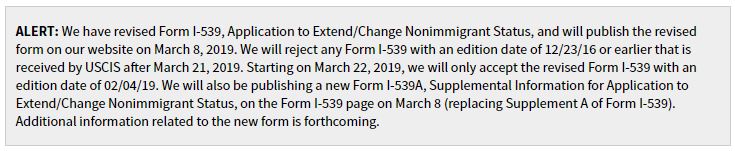
New Version of Form I-539 Effective March 22, 2019
Via AILA.org
On March 1, 2019, USCIS held a teleconference to discuss revised Form I-539 and new Form I-539A. USCIS provided the following updates during the engagement, among others:
- An official copy of the revised Form I-539 and new form I-539A will be published on the USCIS website on March 8, 2019.
- New rollout period:
- USCIS will continue accepting Form I-539 with an edition date of 12/23/16 until March 21, 2019, as long as it is received by USCIS by that date.
- USCIS will reject any Form I-539 with an edition date of 12/23/16 that is received by USCIS after March 21, 2019.
- Starting on March 22, 2019, USCIS will only accept the revised Form I-539 with an edition date of 02/04/19.
This information is currently posted on the I-539 page of the USCIS website.
Update on USCIS Final Rule on Changes to the H-1B Lottery Process
USCIS’s final rule on changes to the H-1B lottery process adds a requirement that petitioners seeking to file H-1B petitions subject to the regular cap, including those eligible for the advanced degree exemption, first electronically register with USCIS during a designated period. However, USCIS is suspending this proposed registration requirement for the FY2020 cap season in order to complete testing of the new registration system.
The rule also reverses the order by which USCIS selects H-1B registrations (or petitions, for FY2020 or any other year in which the registration requirement is suspended) by first selecting registrations submitted on behalf of all beneficiaries, including those eligible for the advanced degree exemption. USCIS will then select from the remaining registrations a sufficient number projected as needed to reach the advanced degree exemption. This change to the order of the selection process will be implemented for the FY2020 cap season. The rule will be published in the Federal Register on 1/31/19 and will be effective 60 days from the date of publication.
USCIS’s announcement follows:
 The U.S. Immigration Law Blog by Ashwin Sharma
UPDATE: AILA REPORTS VSC OPEN — ORIGINAL POST: AILA Reports that USCIS’s Vermont Service Center Is Temporarily Closed on April 10, 2020 due to COVID19
UPDATED POST
Via AILA.org – April 13, 2020
ORIGINAL POST
Via AILA.org – April 10, 2020
On behalf of myself and other Immigration Lawyers across the US: our prayers are with the VSC Staff. The volume of complex cases they assess and adjudicate every day is underappreciated, as is the critical importance of their work. We hope this issue is cleared up soon, and that the people at VSC are safe.