
The President asked Secretary Johnson and Attorney General Eric Holder to undertake a rigorous and inclusive review to inform recommendations on reforming our broken immigration system through executive action. This review sought the advice and input from the men and women charged with implementing the policies, as well as the ideas of a broad range of stakeholders and Members of Congress from both sides of the aisle. Our assessment identified the following ten areas where we, within the confines of the law, could take action to increase border security, focus enforcement resources, and ensure accountability in our immigration system.
Archive | Citizenship and Naturalization
RSS for this section
Quoted by the Times of India in its article titled, “Citizenship by birth to be curtailed by incoming US President Trump, will impact 1 million Indians in green card queue”
I was quoted by the Times of India in its article titled, “Citizenship by birth to be curtailed by incoming US President Trump, will impact 1 million Indians in green card queue”:
Ashwin Sharma, immigration attorney said, “The 14th Amendment guarantees citizenship to ‘all persons born or naturalized in the United States, and subject to the jurisdiction thereof.’ For over a century, courts have consistently interpreted this clause to mean that all children born on U.S. soil are citizens, so long as their parents are within the bounds of US law. Documented migrants, like those on H-1B, L-1 (intra company transfers), and F-1 (international students) visas, clearly fall into this category. Therefore, I am quite certain this proposed executive order would not hold up in court and their children would be entitled to birthright citizenship.”
Attorney Ashwin Sharma Interviewed by BBC Radio (Hindi) on President Trump’s Proposed Plans to End Birthright Citizenship in the U.S.
Ashwin Sharma was interviewed by BBC Radio (Hindi) on President Trump’s recent announcement that he intends to end birthright citizenship in the USA through an Executive Order.
Link to BBC News Site – Full Story
Link to Interview Excerpt on on Birthright Citizenship
By way of background, President Trump had stated earlier this week that, “We’re the only country in the world where a person comes in and has a baby, and the baby is essentially a citizen of the United States.” However this is incorrect, as at least three dozen other countries, including Canada and Mexico, follow the principles of “Jus Soli”, Latin for “right of the soil”, as a near unconditional basis for citizenship.
Birthright Citizenship in the United States is guaranteed by the 14th Amendment to the Constitution, which states, “All persons born or naturalized in the United States, and subject to the jurisdiction thereof, are citizens of the United States and of the State wherein they reside.” Thus, an Executive Order alone, even one with a magical signature, cannot effect the changes to Birthright Citizenship as proposed by the President.
Key Facts on President Obama’s Immigration Action – Via USCIS.gov
Via USCIS.gov
Fixing Our Broken Immigration System Through Executive Action – Key Facts
USCIS Regular and Military Naturalization Form N-400 Average Cycle Time (January 2012 – June 2012)
USCIS Regular and Military Naturalization Form N-400 Average Cycle Time (January 2012 – June 2012) ( PDF)
Data as of June 30, 2012
Published August 20, 2012
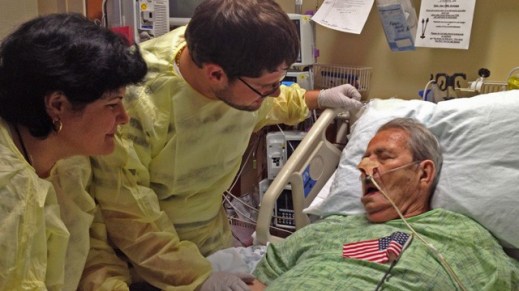
Dying wish to become U.S. citizen granted
Via Channel 4 News
Attorney Ashwin Sharma was recently interviewed by Channel 4 News, Jacksonville in regards to his firm’s Pro Bono representation in coordinating an expedited Naturalization ceremony for Mr. Seferi.
USCIS Improves Processing for Naturalization and Citizenship Forms
WASHINGTON — U.S. Citizenship and Immigration Services (USCIS) is enhancing the filing process for select forms dealing with naturalization and citizenship (N-Forms). Beginning Oct. 30, 2011, the new process will allow individuals to file N-Forms at a secure Lockbox facility instead of our local offices. This change streamlines the way forms are processed, accelerates the collection and deposit of fees and improves the consistency of our intake process.
Individuals should begin submitting affected forms directly to the appropriate Lockbox beginning Oct. 30, 2011. Forms received by local USCIS offices during a transition period between Oct. 30 and Dec. 2, 2011, will be forwarded to the USCIS Lockbox facility for processing. Forms received at local USCIS offices after Dec. 2, 2011, will no longer be forwarded but will be returned to the individual with instructions on how to re-file at a designated USCIS Lockbox facility. USCIS will centralize intake of Forms N-336, N-600 and N-600K at the Phoenix Lockbox facility. The Dallas Lockbox facility will handle the Form N-300. Individuals filing Form N-400, Application for Naturalization, already file at a Lockbox facility.
The following table lists N-Forms affected by this filing change:
|
Affected N-Forms |
Date that Lockbox starts accepting |
Last receipt date that local offices will forward |
|
Sunday, Oct. 30, 2011 |
Friday, Dec. 2, 2011 |
USCIS has updated the information on our N-Form Web pages regarding filing forms at a Lockbox to clearly identify this change in procedure. Please carefully read the form instructions before filing your form to ensure that you are filing the correct form type at the correct location. Any individual submitting the wrong form type for the benefit sought will not receive a fee refund. Instead, individuals will have to re-apply using the correct form and pay a new fee.
Citizenship/Naturalization Test
VIA USCIS
The Naturalization Test
To become a naturalized U.S. citizen, you must pass the naturalization test. At your naturalization interview, you will be required to answer questions about your application and background. You will also take an English and Civics test unless you qualify for an exemption or waiver.
Study Materials
USCIS offers a variety of study materials, including:
These and other citizenship resources for immigrants, educators, and organizations are available on the Citizenship Resource Center website.
Exceptions from English & Civics Requirements
For information on exceptions or modifications to the English and civics requirements for naturalization, visit our Exceptions & Accommodations page.
If You Don’t Pass
You will be given two opportunities to take the English and Civics tests and to answer all questions relating to your naturalization application in English. If you fail any of the tests at your initial interview, you will be retested on the portion of the test that you failed (English or Civics) between 60 and 90 days from the date of your initial interview. See 8 CFR 312.5(a) and 335.3(b).
US Department of State Announces a Redesigned Birth Abroad Certificate
Media Note
Office of the Spokesman
Washington, DC
December 22, 2010
The Department of State is pleased to announce the introduction of a redesigned Consular Report of Birth Abroad (CRBA). The CRBA is an official record confirming that a child born overseas to a U.S. citizen parent acquired U.S. citizenship at birth. The redesigned document has state-of-the-art security features that make it extremely resistant to alterations or forgery.
CRBAs have been printed at U.S. Embassies and Consulates around the world since their introduction in 1919. Effective January 3, 2011, CRBAs will be printed at our passport facilities in Portsmouth, New Hampshire and New Orleans, Louisiana. Centralizing production and eliminating the distribution of controlled blank form stock throughout the world ensures improved uniform quality and lessens the threat of fraud.
Applications for U.S. passports and the redesigned CRBA will also use the title of “parent” as opposed to “mother” and “father.” These improvements are being made to provide a gender neutral description of a child’s parents and in recognition of different types of families.
For media inquiries regarding the CRBA, please contact CAPRESSREQUESTS@state.gov or 202-647-1488.
PRN: 2010.1854
Naturalization Fact Sheet
VIA USCIS.gov
The United States has a long history of welcoming immigrants from all parts of the world. During the last decade, U.S. Citizenship and Immigration Services (USCIS) welcomed more than 6.8 million naturalized citizens into the fabric of our nation. Thus far in fiscal year 2010, approximately 495,232 individuals have been naturalized.
Deciding to become a U.S. citizen can be a very important milestone in an immigrant’s life. Individuals must demonstrate a commitment to the unifying principles that bind us as Americans and in return, will enjoy many of the rights and privileges that are fundamental to U.S. citizenship.
About the Naturalization Process
In general, an individual over the age of 18 seeking to become a citizen of the United States must apply for naturalization by filing an Application for Naturalization, Form N-400. To be eligible for naturalization, an applicant must fulfill certain eligibility requirements set forth in the Immigration and Nationality Act (INA).
These general eligibility requirements specify that the applicant must:
Be at least 18 years of age
Be a lawful permanent resident (green card holder)
Have resided in the United States for at least five years
Have been physically present in the United States for at least 30 months
Be a person of good moral character
Be able to speak, read, write and understand the English language
Have knowledge of U.S. government and history
Be willing and able to take the Oath of Allegiance
Special naturalization provisions exempt certain applicants from one or more of the general requirements for naturalization. Spouses of U.S. citizens and members of the military constitute the main categories of individuals who are exempt from some of the general requirements for naturalization.
The majority of individuals naturalizing as spouses of U.S. citizens may do so three years after being admitted as lawful permanent residents, rather than the five years prescribed under the general provisions.
Spouses of U.S. citizens stationed abroad may not be required to meet any particular residence or physical presence requirement.
Members of the military who served honorably during certain periods of conflict may be eligible for naturalization even though they have not been admitted as lawful permanent residents and even if they are under the age of 18.
Members of the military who served honorably for at least one year, at any time, and apply for naturalization within a certain time after their military service, are also exempt from the general residence and physical presence requirements.
In addition to these naturalization provisions, the INA also provides for the naturalization of children who are under the age of 18.
A child under the age of 18, who is a lawful permanent resident residing in the United States in the legal and physical custody of a U.S. citizen parent, may automatically acquire U.S. citizenship. To obtain evidence of U.S. citizenship, an Application for Certificate of Citizenship, Form N-600, must be filed on behalf of the child.
A child who is residing abroad, who is temporarily present in the U.S. based an any lawful admission, may be eligible to apply for naturalization while under the age of 18 if he or she has at least one parent who is a citizen of the United States, and the parent (or qualifying grandparent) meets certain physical presence requirements in the United States.
There are exemptions benefiting children of active-duty members of the military stationed abroad.
All persons filing an Application for Naturalization who have submitted a complete application along with all required documents will be scheduled for an interviewed by a USCIS officer. Those applicants found qualified are scheduled for an oath ceremony before a judge or an officer delegated the authority by the Director of USCIS to administer the Oath of Allegiance. Applicants do not become U.S. citizens until they have taken the Oath.
Naturalization Statistics
Each year, USCIS welcomes approximately 680,000 citizens during naturalization ceremonies across the United States and around the world.
In FY 2009, 74 percent of all persons naturalizing resided in 10 states (in descending order): California, New York, Florida, Texas, New Jersey, Illinois, Virginia, Massachusetts, Washington and Maryland.
In FY 2009, the leading metropolitan areas of residence were New York-Northern New Jersey-Long Island, NY-NJ-PA (15 percent), Los Angeles-Long Beach-Santa Ana, CA (11 percent) and Miami-Fort Lauderdale-Pompano Beach, FL (7.3 percent).
In FY 2009, the top countries of origin for naturalization were in the following order: Mexico, India, Philippines, China and Vietnam.
Since September 2001, USCIS has naturalized more than 62,763 members of the military, in ceremonies across the United States and in the following 20 countries: Afghanistan, Djibouti, China, Cuba, El Salvador, Germany, Greece, Haiti, Honduras, Iceland, Iraq, Italy, Japan, Kenya, Kosovo, Kuwait, Philippines, South Korea, Spain, and the United Kingdom.
Since 2008, USCIS has naturalized 809 military spouses during ceremonies in Bulgaria, China, Germany, Italy, Japan, Kuwait, Oman, Panama, Philippines, South Korea, Spain, Thailand, Turkey and the United Kingdom.
Total Naturalized Citizens: Fiscal Years 2000-2009
2009 743,715 2004 537,151
2008 1,046,539 2003 463,204
2007 660,477 2002 573,708
2006 702,589 2001 608,205
2005 604,280 2000 888,788
For additional information on USCIS and its programs, visit <a href="http://www.uscis.gov.
“>www.uscis.gov.
Last updated:09/17/2010
Naturalization Process for the Military Fact Sheet
VIA USCIS
USCIS recognizes the important sacrifices made by non-citizen members of the United States armed forces and their families, and is committed to processing their naturalization applications in a timely and efficient manner while providing exemplary customer service, maintaining the integrity of the immigration system, and the security of the process. Qualifying military service is generally in the Army, Navy, Air Force, Marine Corps, Coast Guard, and certain components of the National Guard and the Selected Reserve of the Ready Reserve.
Qualifications
- While a member of the U.S. armed forces must meet the general requirements and qualifications to become a citizen of the United States, such as good moral character, some of the other requirements are either reduced or completely waived. Specifically, qualifying service members and certain veterans are not required to demonstrate residence or physical presence in the United States, and are not required to pay an application fee or a biometrics fee to apply for naturalization. In addition, service members who serve during specifically designated periods of hostilities may not need to be lawful permanent residents.
- The National Defense Authorization Act for Fiscal Year 2004extended all aspects of the naturalization process, including naturalization applications, interviews, oaths and ceremonies to members of the U.S. armed forces serving abroad. Before Oct. 1, 2004, service members could only naturalize while physically within the United States.
- The National Defense Authorization Act for Fiscal Year 2008added Sections 319(e) and 322(d) to the Immigration and Nationality Act (INA), which allows certain eligible spouses and children of members of the U.S. armed forces to naturalize abroad without traveling to the United States for any part of the naturalization process.
Service in Wartime (INA Section 329)
- Members of the military, who serve during specifically designated periods of hostilities, may qualify for naturalization under this provision if they have served honorably in an active duty status for any period of time, and if that service was during a specifically designated period of hostility.
- Unlike all other provisions for naturalization, a qualifying service member is not required to be a lawful permanent resident to naturalize under this provision if the service member enlisted, or was inducted within the United States or other qualifying geographical area.
- The Expedited Naturalization Executive Order of 2002provides for expedited naturalization under this provision to qualified aliens and non-citizen nationals serving honorably in an active-duty status in the U.S. armed forces beginning on Sept. 11, 2001 to the present. This section also covers veterans of designated past wars and conflicts.
Service in Peacetime (INA Section 328)
An individual may qualify for naturalization under this provision if he or she:
- Served honorably in the military for at least one year
- Obtained lawful permanent resident status
- Filed an application while still in the service or within six months of separation.
Assistance to the Military Community
- Specially trained USCIS customer service specialists provide assistance with naturalization and immigration issues over the military help line, 1-877-CIS-4MIL (1-877-247-4645) and e-mail service, militaryinfo.nsc@dhs.gov, established exclusively for the military and their families.
- USCIS also posts information for the military online athttp://www.uscis.gov/military.
- Specialists across USCIS have been selected to handle military naturalization packets. They consider this a privilege and an honor, and do all that they can to ensure that applications are processed and completed as expeditiously as possible.
- In addition, each military installation has a designated point-of-contact to assist service members in preparing and filing their naturalization application packet. This person is usually in the military legal office or in the personnel division.
Application Packet (from a member of the military)
- Application for Naturalization, (USCIS Form N-400)
- Request for Certification of Military or Naval Service, (USCIS Form N-426)
- If applicable, a copy of the USCIS Form I 551, Permanent Resident Card; and
- Two passport-style photographs.
- NOTE – There is no fee for members of the military applying for naturalization under INA Sections 328 or 329.
Five Fingerprinting Methods Available to Service Members
- Have the fingerprints taken at any USCIS Application Support Center (ASC) in the United States without an appointment even if their application is not yet pending with USCIS.
- Have the fingerprints taken at select military installations in the United States by USCIS personnel using mobile fingerprinting equipment.
- If USCIS has useable fingerprints on file (taken for immigration purposes), USCIS will re-submit these fingerprints to the FBI.
- The service member may authorize USCIS to acquire and use the fingerprints taken at the time of enlistment by completing and submitting the Fingerprint Authorization.
- Have their fingerprints taken at U.S. military installations overseas or at U.S. Embassies and Consulates using the FD-258 fingerprint card.
Statistics
- Since September 2001, USCIS has naturalized more than 58,300 members of the military, in ceremonies across the United States and in the following 19 countries: Afghanistan, Djibouti, China, Cuba, El Salvador, Germany, Greece, Honduras, Iceland, Iraq, Italy, Japan, Kenya, Kosovo, Kuwait, Philippines, South Korea, Spain, and the United Kingdom.
- Since August 2002, USCIS has granted posthumous citizenship to 130 members of the military.
- Since 2008, USCIS has naturalized 592 military spouses during ceremonies in Bulgaria, China, Germany, Italy, Japan, Kuwait, Panama, South Korea, Spain, Turkey, and the United Kingdom.
- Since 2009, USCIS has presented 19 military children with citizenship certificates during ceremonies in Germany, Japan, South Korea and the United Kingdom.
Last updated:05/24/2010
USCIS List of Naturalization Publications and Study Materials
VIA USCIS.gov
On March 10, 2009, USCIS released a list of naturalization publications for applicants, as well as study materials for the naturalization exam.
|
USCIS Announces New Edition for Form N-400 Posted to Website
USCIS announced that a January 22, 2009, edition for Form N-400, Application for Naturalization, has been posted to the USCIS website. Certain previous editions are being accepted and are listed on the N-400 webpage.
 The U.S. Immigration Law Blog by Ashwin Sharma
Quoted by the Times of India on President Trump’s Executive Order “Protecting the Meaning and Value of American Citizenship”
I was quoted by the Times of India on President Trump’s Executive Order “Protecting the Meaning and Value of American Citizenship,” in which he stipulates that at least one parent now must be a U.S. citizen or lawful permanent resident for a child to obtain U.S. citizenship at birth. This order appears to directly contravene the 14th Amendment, which unequivocally states:
“All persons born or naturalized in the United States, and subject to the jurisdiction thereof, are citizens of the United States.”
The phrase “subject to the jurisdiction thereof” has been consistently interpreted to include nearly all individuals born on U.S. soil, irrespective of their parents’ immigration status, other than children of enemy occupiers or diplomats. The landmark Supreme Court case United States v. Wong Kim Ark (1898) reaffirmed this interpretation, granting citizenship to a child born in the U.S. to Chinese immigrant parents who were not U.S. citizens. This decision established a precedent which leaves little room for reinterpretation.
The President’s argument hinges on a selective and self-serving reinterpretation of “subject to the jurisdiction thereof.” The sweeping language of the executive order excludes from eligibility the children of undocumented immigrants as well as children of legal nonimmigrants, such as H-1B/L-1/TN workers, F-1 students, and other temporary residents. By placing the citizenship of these U.S.-born children in jeopardy, the order creates great uncertainty for immigrant families who have long contributed to the U.S. economy and society. And for a President who claims to champion merit and hard work, this order is a harsh blow to those who exemplify those very ideals. Many of these individuals, particularly those in H-1B status, have spent a decade or more navigating the labyrinthine immigration system, paying taxes, and contributing to their communities, only to face the prospect of their children inheriting the same uncertainty and lengthy delays that they themselves endured. By erecting new barriers to their children’s inclusion, it undermines the foundation of a nation built on the promise of opportunity and equality for all.
This EO will undoubtedly face swift and intense legal challenges; the ACLU has already filed suit. No stroke of a pen in the West Wing can override the 14th Amendment, and it is all but certain that the courts will strike this order down as unconstitutional.
TOI Article Links below:
https://timesofindia.indiatimes.com/world/us/citizenship-by-birth-curtailed-even-for-legal-immigrants-over-1-million-indians-in-green-card-queue-impacted/articleshow/117419508.cms
https://timesofindia.indiatimes.com/world/us/first-lawsuit-filed-in-us-district-court-contesting-end-to-citizenship-by-birth/articleshow/117421279.cms