
FY 2013 H-1B Cap Count as of 04/20/2012
FY 2013 H-1B Cap Count
|
Cap Type |
Cap Amount |
Cap Eligible Petitions |
Date of Last Count |
|
H-1B Regular Cap |
65,000 |
25,000 |
04/20/2012 |
|
H-1B Master’s Degree Exemption |
20,000 |
10,900 |
04/20/2012 |
H-1B Cap count for April 13, 2012
H-1B Cap count for April 13, 2012, about 20,600 cap-subject petitions have been taken in. As well, USCIS has accepted about 9,700 H-1B petitions for the advanced degree cap.
Dying wish to become U.S. citizen granted
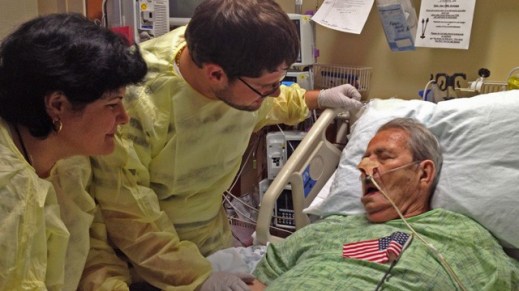
Via Channel 4 News
USCIS Changes Look and Feel of Form I-797C
WASHINGTON – On April 2, 2012, USCIS will issue Form I-797C, Notice of Action, with a new look and feel. We will print the Form I-797C on plain bond paper. This change is estimated to save the agency about $1.1 million per year.
This form change will help reduce public perception that the Form I-797C demonstrates evidence of an immigration benefit or status. The top of the new Form I-797C will clearly display: “THIS NOTICE DOES NOT GRANT ANY IMMIGRATION STATUS OR BENEFIT.” The following is a sample of how this disclaimer will appear on the Form I-797C:

Please note, the Form I-797C, Notice of Action is used ONLY for certain types of communication between individuals and the agency including notifications of:
- Receipt (notifies the customer that their payment and application/petition has been received by USCIS)
- Rejection (notifies the customer that their application/petition has been rejected due to incorrect information or payment)
- Transfer (notifies the customer that their case was relocated to another USCIS office for processing)
- Re-Open (notifies the customer that USCIS has approved a motion to re-open their completed case and it is being processed)
- Appointment (notifies the customer that they have an appointment with USCIS to obtain fingerprint or biometric capture, to attend an interview, or that their appointment has been rescheduled)
Form I-797C appointment notices will also contain disability accommodation information on the back of the form. Previously this information was included as a separate flyer that was sent along with the notice. Printing this information on the back of the form will save additional resources by consolidating the notice and disability information into one form.
Form I-797C Notice of Actions issued before April 2, 2012, will remain valid. This change to Form I-797C is part of our ongoing efforts to improve customer service while enhancing agency operations.
For more information on USCIS a
nd its programs, please visit www.uscis.gov or follow us on Twitter (@uscis ), YouTube (/uscis) and the USCIS blog The Beacon.
Last updated:03/30/2012
USCIS Proposes Process Change for Certain Waivers of Inadmissibility
Released by USCIS: March 30, 2012
Proposal would reduce time that U.S. citizens are separated from immediate relatives
WASHINGTON—U.S. Citizenship and Immigration Services (USCIS) today posted a Notice of Proposed Rulemaking (NPRM) in the Federal Register that would reduce the time U.S. citizens are separated from their spouses, children, and parents (i.e. immediate relatives) who must obtain an immigrant visa abroad to become lawful permanent residents of the United States. This rule would allow certain immediate relatives of U.S. citizens to apply for a provisional waiver of the unlawful presence ground of inadmissibility while still in the United States if they can demonstrate that being separated from their U.S. citizen spouse or parent would cause that U.S. citizen relative extreme hardship. The proposed rule will not alter how USCIS determines eligibility for a waiver of inadmissibility or how an individual establishes extreme hardship.
“The law is designed to avoid extreme hardship to U.S. citizens, which is precisely what this proposed rule will more effectively achieve,” said USCIS Director Alejandro Mayorkas. “The current process can subject U.S. citizens to months of separation from family members who are waiting for their cases to be processed overseas. The proposed change will have tremendous impact on families by significantly reducing the time of separation.”
USCIS also proposes creating a new form for immediate relatives of U.S. citizens who choose to apply for a provisional unlawful presence waiver. Once in effect, this form would be used for individuals filing an application for a provisional unlawful presence application before he or she departs the United States to complete the immigrant visa process at a U.S. Embassy or consulate abroad. The streamlined process would only apply to immediate relatives who are otherwise eligible for an immigrant visa based on an approved immediate relative petition.
The proposed process outlined above is not in effect and is not available until USCIS publishes a final rule with an effective date in the Federal Register. USCIS will consider all public comments on the proposed rule announced today before publishing the final rule in the coming months. Individuals at this time should not to submit an application for a provisional unlawful presence waiver, or allow anyone to submit one on their behalf because it will be rejected.
USCIS encourages the public to submit formal input on the proposed rule through www.regulations.gov during a comment period that runs from April 2, 2012 until June 1, 2012.
A detailed Web page addressing the proposed rule is currently posted to http://www.uscis.gov/provisionalwaiver. Additional details on the proposed process changes will be available at www.regulations.gov on April 2, 2012. For more information on USCIS and its programs and services, please visit www.uscis.gov or follow us on Twitter (@uscis), YouTube (/uscis) and the USCIS blog The Beacon.
Last updated:04/04/2012
DHS Yearbook of Immigration Statistics: 2011
Data on individuals who became Legal Permanent Residents in 2011
|
Table # |
Title |
|
Persons Obtaining Legal Permanent Resident Status: Fiscal Years 1820 to 2011 |
|
|
Persons Obtaining Legal Permanent Resident Status by Region and Selected Country of Last Residence: Fiscal Years 1820 to 2011 |
|
|
Persons Obtaining Legal Permanent Resident Status by Region and Country of Birth: Fiscal Years 2002 to 2011 |
|
|
Persons Obtaining Legal Permanent Resident Status by State or Territory of Residence: Fiscal Years 2002 to 2011 |
|
|
Persons Obtaining Legal Permanent Resident Status by Core Based Statistical Area (CBSA) of Residence: Fiscal Years 2002 to 2011 |
|
|
Persons Obtaining Legal Permanent Resident Status by Type and Major Class of Admission: Fiscal Years 2002 to 2011 |
|
|
Persons Obtaining Legal Permanent Resident Status by Type and Detailed Class of Admission: Fiscal Year 2011 |
|
|
Persons Obtaining Legal Permanent Resident Status by Gender, Age, Marital Status, and Occupation: Fiscal Year 2011 |
|
|
Persons Obtaining Legal Permanent Resident Status by Broad Class of Admission and Selected Demographic Characteristics: Fiscal Year 2011 |
|
|
Persons Obtaining Legal Permanent Resident Status by Broad Class of Admission and Region and Country of Birth: Fiscal Year 2011 |
|
|
Persons Obtaining Legal Permanent Resident Status by Broad Class of Admission and Region and Country of Last Residence: Fiscal Year 2011 |
|
|
Immigrant Orphans Adopted by U.S. Citizens by Gender, Age, and Region and Country of Birth: Fiscal Year 2011 |
Supplemental Tables
|
Table # |
Title |
|
Persons Obtaining Legal Permanent Resident Status by State or Territory of Residence and Region and Country of Birth: Fiscal Year 2011 |
|
|
Persons Obtaining Legal Permanent Resident Status by Leading Core Based Statistical Areas (CBSAs) of Residence and Region and Country of Birth: Fiscal Year 2011 |
|
|
Persons Obtaining Legal Permanent Resident Status by Region of Birth and Core Based Statistical Area (CBSA) of Residence: Fiscal Year 2011 |
|
|
Immigrant-Orphans Adopted by U.S. Citizens by State or Territory of Residence, Gender, and Age: Fiscal Year 2011 |
FY 2013 H-1B Cap Count as of 04/09/2012
FY 2013 H-1B Cap Count
|
Cap Type |
Cap Amount |
Cap Eligible Petitions |
Date of Last Count |
|
H-1B Regular Cap |
65,000 |
17,400 |
04/09/2012 |
|
H-1B Master’s Degree Exemption |
20,000 |
8,200 |
04/09/2012 |
H-1B Cap Count – as of April 5, 2012 – Double the cases filed as compared to last year about this time
Q & A: Extension of Post-Completion Optional Practical Training (OPT) and F-1 Status for Eligible Students under the H-1B Cap-Gap Regulations
VIA USCIS
Introduction
These Questions & Answers address the automatic extension of F-1 student status in the United States for certain students with pending or approved H-1B petitions (indicating a request for change of status from F-1 to H-1B) for an employment start date of October 1, 2012 under the Fiscal Year (FY) 2013 H-1B cap.
Questions & Answers
Q1. What is “Cap-Gap”?
A1. Current regulations allow certain students with pending or approved H-1B petitions to remain in F-1 status during the period of time when an F-1 student’s status and work authorization would otherwise expire through the start date of their approved H-1B employment period. This is referred to as filling the “cap-gap,” meaning the regulations provide a way of filling the “gap” between the end of F-1 status and the beginning of H-1B status that might otherwise occur if F-1 status is not extended for qualifying students.
Q2. How does “Cap-Gap” Occur?
A2. An employer may not file, and USCIS may not accept, an H-1B petition submitted more than six months in advance of the date of actual need for the beneficiary’s services or training. As a result, the earliest date that an employer can file an FY 2013 H-1B cap-subject petition is April 2, 2012 for employment starting not before October 1, 2012. If USCIS approves the H-1B petition and the accompanying change of status request, the earliest date that the student may start the approved H-1B employment is October 1, 2012. Consequently, F-1 students whose periods of authorized stay expire before October 1, 2012, and who do not qualify for a cap-gap extension, are required to leave the United States, apply for an H-1B visa at a consular post abroad, and then seek readmission to the United States in H-1B status, for the dates reflected on the approved H-1B petition.
Q3. Which petitions and beneficiaries qualify for a cap-gap extension?
A3. H-1B petitions that are timely filed on behalf of an eligible F-1 student and request a change of status to H-1B on October 1, 2012 qualify for a cap-gap extension.
Timely filed means that the H-1B petition (indicating change of status rather than consular processing) was filed during the H-1B acceptance period, which begins Monday April 2, 2012, while the student’s authorized F-1 duration of status (D/S) admission was still in effect (including any period of time during the academic course of study, any authorized periods of post-completion Optional Practical Training (OPT), and the 60-day departure preparation period, commonly known as the “grace period”).
Once a timely filed request to change status to H-1B on October 1, 2012 has been made, the automatic cap-gap extension will begin and will continue until the H-1B petition adjudication process has been completed. If the student’s H-1B petition is selected and approved, the student’s extension will continue through September 30, 2012 unless the petition is denied, withdrawn, or revoked. If the student’s H-1B petition is not selected, the student will have the standard 60-day grace period from the date of the rejection notice or their program end date, whichever is later, to prepare for and depart the United States.
Students are strongly encouraged to stay in close communication with their petitioning employer during the cap-gap extension period for status updates on the H-1B petition processing.
Q4. How does a student covered under the cap-gap extension obtain proof of continuing status?
A4. The student should go to their Designated School Official (DSO) with evidence of a timely filed H-1B petition (indicating a request for change of status rather than for consular processing), such as a copy of the petition and a FedEx, UPS, or USPS Express/certified mail receipt. The student’s DSO will issue a preliminary cap-gap I-20 showing an extension until June 1, 2012.
If the H-1B petition is selected for adjudication, the student should return to his or her DSO with a copy of the petitioning employer’s Form I-797, Notice of Action, with a valid receipt number, indicating that the petition was filed and accepted. The student’s DSO will issue a new cap-gap I-20 indicating the continued extension of F-1 status.
Q5. Is a student who becomes eligible for an automatic cap-gap extension of status and employment authorization, but whose H-1B petition is subsequently rejected, denied or revoked, still allowed the 60-day grace period?
A5. If USCIS denies, rejects, or revokes an H-1B petition filed on behalf of an F-1 student covered by the automatic cap-gap extension
of status, the student will have the standard 60-day grace period (from the date of the notification of the denial, rejection, or revocation of the petition) before he or she is required to depart the United States.
For denied cases, it should be noted that the 60-day grace period does not apply to an F-1 student whose accompanying change of status request is denied due to the discovery of a status violation. The student in this situation is not eligible for the automatic cap-gap extension of status or the 60-day grace period. Similarly, the 60-day grace period and automatic cap-gap extension of status would not apply to the case of a student whose petition was revoked based on a finding of fraud or misrepresentation discovered following approval. In both of these instances, the student would be required to leave the United States immediately.
Q6. May students travel outside the United States during a cap-gap extension period and return in F-1 status?
A6. No. A student granted a cap-gap extension who elects to travel outside the United States during the cap-gap extension period will not be able to return in F-1 status. The student will need to apply for an H-1B visa at a consular post abroad prior to returning. As the H-1B petition is for an October 1, 2012 start date, the student should be prepared to adjust his or her travel plans, accordingly.
Q7. What if a student’s post-completion OPT has expired and the student is in a valid grace period when an H-1B cap-subject petition is filed on their behalf? It appears that F-1 status would be extended, but would OPT also be extended?
A7. F-1 students who have entered the 60-day grace period are not employment-authorized. Consequently, if an H-1B cap-subject petition is filed on the behalf of a student who has entered the 60-day grace period, the student will receive the automatic cap-gap extension of his or her F-1 status, but will not become employment-authorized (since the student was not employment-authorized at the time H-1B petition was filed, there is no employment authorization to be extended).
Q8. Do the limits on unemployment time apply to students with a cap-gap extension?
A8: Yes. The 90-day limitation on unemployment during the initial post-completion OPT authorization continues during the cap-gap extension.
Q9. What is a STEM OPT extension?
A9. F-1 students who receive science, technology, engineering, and mathematics (STEM) degrees included on the STEM Designated Degree Program List, are employed by employers enrolled in E-Verify, and who have received an initial grant of post-completion OPT employment authorization related to such a degree, may apply for a 17-month extension of this authorization. F-1 students may obtain additional information about STEM OPT extensions on the Student and Exchange Visitor Program website at www.ice.gov/sevis.
Q10. May a student eligible for a cap-gap extension of post-completion OPT employment authorization and F-1 status apply for a STEM OPT extension while he or she is in the cap-gap extension period?
A10. Yes. However, such application may not be made once the cap-gap extension period is terminated (e.g., if the H-1B petition is rejected, denied, or revoked), and the student has entered the 60-day departure preparation period.
Q11. In recent years, employers have been able to file H-1B cap-subject petitions after April 1, and have not always requested an October 1 start date. However, some students’ OPT end dates were nevertheless shortened to September 30, even though their H-1B employment would not begin until a later date. What should the student do to correct this?
A11. The student should contact their DSO. The DSO may request a data fix in SEVIS by contacting the SEVIS helpdesk.
Q12. If the student finds a new H-1B job, can he or she continue working with his/her approved EAD while the data fix in SEVIS is pending?
A12. Yes, if the (former) H-1B employer timely withdrew the H-1B petition and the following conditions are true:
§ the student finds employment appropriate to his or her OPT;
§ the period of OPT is unexpired; and
§ the DSO has requested a data fix in SEVIS.
Note: If the student had to file Form I-539 to request rei
nstatement to F-1 student status, the student may not work or attend classes until the reinstatement is approved.
Q13. If the student has an approved H-1B petition and change of status, but is laid off/terminated by the H-1B employer before the effective date, and the student has an unexpired EAD issued for post-completion OPT, can the student retrieve any unused OPT?
A13.Yes. The student will remain in student status and can continue working OPT using the unexpired EAD until the H-1B change of status goes into effect. The student also needs to make sure that USCIS receives a withdrawal request from the petitioner before the H-1B change of status effective date. This will prevent the student from changing to H-1B status. Once the petition has been revoked, the student must provide their DSO with a copy of the USCIS acknowledgement of withdrawal (i.e., the notice of revocation). The DSO may then request a data fix in SEVIS, to prevent the student from being terminated in SEVIS on the H-1B effective date, by contacting the SEVIS helpdesk.
If USCIS does not receive the withdrawal request prior to the H-1B petition change of status effective date, then the student will need to stop working, file a Form I-539 to request reinstatement, and wait until the reinstatement request is approved before resuming employment.
Q14. In cases where a student is authorized to work OPT past the H-1B change of status effective date, can the student continue working on OPT if a request to revoke/withdraw the H-1B change of status is submitted to USCIS?
A14. If the H-1B revocation occurs before the H-1B change of status effective date, the student may continue working while the data fix remains pending, because the student will still be in valid F-1 status.
If the H-1B revocation occurs on or after the H-1B change of status effective date, the student will need to stop working before the H-1B change of status effective date, apply for reinstatement, and wait until the reinstatement request is approved before resuming employment.
NOTE: This is NOT a cap-gap situation since the student has an EAD authorizing OPT beyond the H-1B change of status effective date.
Q15. Do students remain in valid F-1 status while the request to change the OPT end date is pending?
A15. If the H-1B revocation occurs before the H-1B change of status effective da te, the student is still deemed to be in F-1 status while the data fix is pending.
If the H-1B revocation occurs after the H-1B change of status effective date, the student will not be in valid F-1 status and will therefore either need to apply for reinstatement or depart the United States.
Last updated:03/29/2012
EB-2 Priority Date Movement in FY2012 for China-mainland Born and India expected to retrogress to August 15, 2007
The Impact of Counting Changes on Nonimmigrant Admissions: Preliminary Findings
A National Foundation for American Policy report finds Indian applicants for L-1 and H-1Bs are most likely to be denied or issued an RFE query; L-1 cases for Indian Professionals have been denied up to five times as often as someone from a different count

First page of the US Chinese Exclusion Act (Photo credit: Wikipedia)
A National Foundation for American Policy report which analyzed official data from USCIS revealed evidence that Adjudicating Officers have dramatically increased the issuance of denials and requests for evidence in L-1 (intra-company transferees) and H-1B cases over the last four years, in spite of the fact that there were no changes in law or regulations during the same period. USCIS Officers have, over the last four years, arbitrarily & en masse, increased the difficulty of obtaining H-1B or L-1 status, most particularly for Indian applicants.
Again, this is so despite no new laws or regulations authorizing a change in adjudication protocols. It may be therefore objectively stated that this data is prima facia evidence that Indian IT professionals and their employers have been, over a sustained period, selected for profiling and targeting profiled and targeted as the primary victims of this and other related USCIS “policy changes” since 2008, along with a widely noted increase in visa denials/221(g) queries for H-1 & L-1 non-immigrants at U.S. Consulates [on a related note; see the new “H-1B Beneficiary attestation” evidently now in use at the U.S. Consulate, Hyderabad, ostensibly to be used in justifying mass visa denials for H-1B IT Consultants with end-client job sites].
By way of background, the primary basis for U.S. Immigration law today is the Immigration and Nationality Act of 1965 (“INA”). The INA is tremendously significant because it reversed America’s then (longstanding) racist Immigration policies, including the Page Act of 1875, the 1882 Chinese Exclusion Act and the “National Origins Formula” which had effectively limited immigration from Mediterranean Europe, Latin America and Asia to token levels so as not to change America’s “national character”. It is then truly ironic that adjudicators at the USCIS and U.S. Consulates appear to have been granted unchecked autonomy in systematically countermanding both the INA and its underlying legislative intent by effectively re-proportioning visas or “spots” to countries other than India.
Indians utilize a large number of available H-1B and L-1 numbers, however, they cannot be legally denied on that basis. On October 3, 1965, on the occasion of the signing of the INA, at the foot of the Statue of Liberty, President Lyndon B. Johnson declared that it was a “cruel and enduring wrong” that “…Men of needed skill and talent were denied entrance because they came from southern or eastern Europe or from one of the developing continents. [The old quota based Immigration] system violated the basic principle of American democracy–the principle that values and rewards each man on the basis of his merit as a man…”
Contrast these words with the following excerpts from the NFAP report:
“Companies believe that denials either at U.S. Citizenship and Immigration Services or at consulates, particularly involving Indian nationals, share the common attribute of new (unwritten) arbitrary standards that go beyond the statute and regulations.
…
Country specific data on new (initial) L-1B petitions indicate U.S. Citizenship and Immigration Services is more likely to deny a petition from an Indian-born professional than nationals of other countries. The denial rate for Indian-born applicants for new L-1B petitions rose from 2.8 percent in Fiscal Year 2008 to 22.5 percent in FY 2009, a substantial increase that resulted in many employers being unable to transfer their employees into the United States to work on research projects or serve customers. In comparison, the denial rate for new L-1B petitions for Canadians rose from 2.0 percent in FY 2008 to only 2.9 percent in FY 2009. Illustrating the abrupt change, U.S. Citizenship and Immigration Services denied more L-1B petitions for new petitions for Indians in FY 2009 (1,640) than in the previous 9 fiscal years combined (1,341 denials between FY 2000 and FY 2008).
…
Concern that L-1B petitions for Indians have been singled out might be alleviated if the data showed other countries have experienced similar increases in the rates of denial for L-1B petitions with U.S. Citizenship and Immigration Services. However, the data show that while other foreign nationals experienced an increase in denial rates for new L-1B petitions starting in FY 2009, those denial rate increases were far lower than for Indian nationals. L-1 visa issuance declined at U.S posts in Indian in FY 2011 but rose overall for the rest of the world.”
Read the NFAP findings (.pdf)
 The U.S. Immigration Law Blog by Ashwin Sharma
Supreme Court debate: is Arizona’s Immigration law Constitutional?
Ashwin Sharma participated in an online debate today over the legal issues surrounding Arizona SB 1070. PolicyMic will be hosting the discussion which will include several legal and think-tank scholars on the topic of how the Supreme Court should decide the case.