
Attorney Sharma’s interview with Channel 4 news on President Obama’s new Deferred Action Process for Certain Young People
Individuals who demonstrate that they meet the guidelines below may request consideration of deferred action for childhood arrivals for a period of two years, subject to renewal, and may be eligible for employment authorization.
You may request consideration of deferred action for childhood arrivals if you:
- Were under the age of 31 as of June 15, 2012;
- Came to the United States before reaching your 16th birthday;
- Have continuously resided in the United States since June 15, 2007, up to the present time;
- Were physically present in the United States on June 15, 2012, and at the time of making your request for consideration of deferred action with USCIS;
- Entered without inspection before June 15, 2012, or your lawful immigration status expired as of June 15, 2012;
- Are currently in school, have graduated or obtained a certificate of completion from high school, have obtained a general education development (GED) certificate, or are an honorably discharged veteran of the Coast Guard or Armed Forces of the United States; and
- Have not been convicted of a felony, significant misdemeanor, three or more other misdemeanors, and do not otherwise pose a threat to national security or public safety.
Attorney Sharma defends client who was wrongly accused of being a ‘terrorist’ and barred from entering the United States

Attorney Sharma and our client were interviewed by Channel 4 News yesterday. Our client’s Afghan husband has been wrongly deemed permanently inadmissible to the U.S. under the Terrorism Related Inadmissibility Grounds section in the INA, the same overbroad regulation that many innocent individuals have been unjustly subject to.
For example: an asylee from Burundi was considered a terrorist under this regulation, and jailed for 20 months by the U.S. because he was found to have financially supported the Rebel group that robbed him of $4.00 and a bagged lunch. For fighting against Apartheid, Mr. Nelson Mandela was subjected to this regulation and had to be granted a waiver to enter the U.S. by the then Secretary of State Condoleezza Rice.
Attorney Sharma will be filing an exemption for our client’s husband with the offices of the Secretary of State Hillary Clinton, Secretary of the Department of Homeland Security Janet Napolitano and/or U.S. Attorney General Eric Holder. Our exemption will petition the highest levels of our government to review this case again, and approve an admission to the U.S. if no adverse grounds are discovered.
INFORMATION ON PRESIDENT OBAMA’S RECENTLY ANNOUNCED DEFERRED ACTION PROGRAM ENABLING LEGAL STATUS FOR CERTAIN YOUNG IMMIGRANTS
Jacksonville, FL – Immigration lawyer Ashwin Sharma welcomed the Administration’s recent announcement that younger immigrants may be eligible for “Deferred Action” and work authorization. The policy will grant qualified immigrants the opportunity to live free from fear of deportation and allow them to work legally. This is an exciting new development which brings hope to immigrants and their families. It is not, however, a permanent fix and does not grant permanent legal status to anyone.
To qualify, an individual must:
Attorney Ashwin Sharma interviewed on H-1B visas by Matt O’Brien of the San Jose Mercury News
“H-1Bs are a good indicator of how the economy is doing,” said Florida immigration lawyer Ashwin Sharma. “You only hire an IT consultant when there’s work available, and it’s work that has to be estimated six months in advance. If companies are taking that risk, there’s a belief that the economy is back and there’s money to be made.”
Tech firms triple their recruitment rate for H-1B workers, H-1B visa opponents find their voices again
An accurate and balanced article by Matt O’Brien of the San Jose Mercury News indicates that IT firms’ hiring of H-1B workers has tripled this year, a fact that doesn’t yet indicate a thing to Kim Berry, H-1B opponent and president of the Programmers Guild. Mr. Berry instead quickly moves to politicize the discussion by characterizing H-1B workers as “cheaper not better,” and by referring to H-1B employers as “penny pinchers.”
Mr. Berry is either uninformed or conveniently ignoring the fact that H-1B employers can pay an initial government fee of up to $5,550.00 to file one H-1B petition on behalf of a foreign professional. This amount does not include attorney fees or any guarantees. Mr. Berry’s statements also do not take into consideration the many intellectual and business contributions that H-1B and ex-H-1B workers have made to better his home State of California.
Mr. O’Brien’s article includes a succinct description of President Obama and Mitt Romney’s views on the H-1B program. “Romney’s economic plan proposes raising the visa caps for highly skilled foreign workers,” while President Obama “has not articulated any major changes to the H-1B program.” The latter statement could also have read: ‘…no more major changes have been articulated beyond the near doubling of H-1B filing fees for certain firms, as implemented by this Administration’s Public Law 111-230, and the unchecked increase in unjustified denials, audits and requests for evidence issued of late by the USCIS and US Consulates.’
– Ashwin Sharma, Esq.
Information on Consulates’ use of 221(g) refusals
Supreme Court debate: is Arizona’s Immigration law Constitutional?
Ashwin Sharma participated in an online debate today over the legal issues surrounding Arizona SB 1070. PolicyMic will be hosting the discussion which will include several legal and think-tank scholars on the topic of how the Supreme Court should decide the case.
Dying wish to become U.S. citizen granted
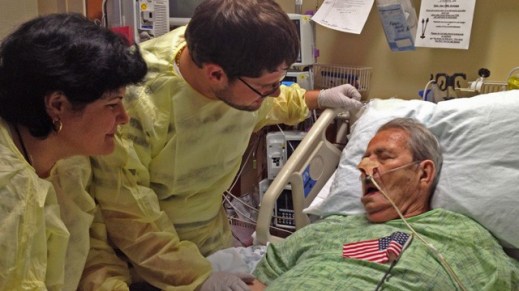
Via Channel 4 News
A National Foundation for American Policy report finds Indian applicants for L-1 and H-1Bs are most likely to be denied or issued an RFE query; L-1 cases for Indian Professionals have been denied up to five times as often as someone from a different count

First page of the US Chinese Exclusion Act (Photo credit: Wikipedia)
A National Foundation for American Policy report which analyzed official data from USCIS revealed evidence that Adjudicating Officers have dramatically increased the issuance of denials and requests for evidence in L-1 (intra-company transferees) and H-1B cases over the last four years, in spite of the fact that there were no changes in law or regulations during the same period. USCIS Officers have, over the last four years, arbitrarily & en masse, increased the difficulty of obtaining H-1B or L-1 status, most particularly for Indian applicants.
Again, this is so despite no new laws or regulations authorizing a change in adjudication protocols. It may be therefore objectively stated that this data is prima facia evidence that Indian IT professionals and their employers have been, over a sustained period, selected for profiling and targeting profiled and targeted as the primary victims of this and other related USCIS “policy changes” since 2008, along with a widely noted increase in visa denials/221(g) queries for H-1 & L-1 non-immigrants at U.S. Consulates [on a related note; see the new “H-1B Beneficiary attestation” evidently now in use at the U.S. Consulate, Hyderabad, ostensibly to be used in justifying mass visa denials for H-1B IT Consultants with end-client job sites].
By way of background, the primary basis for U.S. Immigration law today is the Immigration and Nationality Act of 1965 (“INA”). The INA is tremendously significant because it reversed America’s then (longstanding) racist Immigration policies, including the Page Act of 1875, the 1882 Chinese Exclusion Act and the “National Origins Formula” which had effectively limited immigration from Mediterranean Europe, Latin America and Asia to token levels so as not to change America’s “national character”. It is then truly ironic that adjudicators at the USCIS and U.S. Consulates appear to have been granted unchecked autonomy in systematically countermanding both the INA and its underlying legislative intent by effectively re-proportioning visas or “spots” to countries other than India.
Indians utilize a large number of available H-1B and L-1 numbers, however, they cannot be legally denied on that basis. On October 3, 1965, on the occasion of the signing of the INA, at the foot of the Statue of Liberty, President Lyndon B. Johnson declared that it was a “cruel and enduring wrong” that “…Men of needed skill and talent were denied entrance because they came from southern or eastern Europe or from one of the developing continents. [The old quota based Immigration] system violated the basic principle of American democracy–the principle that values and rewards each man on the basis of his merit as a man…”
Contrast these words with the following excerpts from the NFAP report:
“Companies believe that denials either at U.S. Citizenship and Immigration Services or at consulates, particularly involving Indian nationals, share the common attribute of new (unwritten) arbitrary standards that go beyond the statute and regulations.
…
Country specific data on new (initial) L-1B petitions indicate U.S. Citizenship and Immigration Services is more likely to deny a petition from an Indian-born professional than nationals of other countries. The denial rate for Indian-born applicants for new L-1B petitions rose from 2.8 percent in Fiscal Year 2008 to 22.5 percent in FY 2009, a substantial increase that resulted in many employers being unable to transfer their employees into the United States to work on research projects or serve customers. In comparison, the denial rate for new L-1B petitions for Canadians rose from 2.0 percent in FY 2008 to only 2.9 percent in FY 2009. Illustrating the abrupt change, U.S. Citizenship and Immigration Services denied more L-1B petitions for new petitions for Indians in FY 2009 (1,640) than in the previous 9 fiscal years combined (1,341 denials between FY 2000 and FY 2008).
…
Concern that L-1B petitions for Indians have been singled out might be alleviated if the data showed other countries have experienced similar increases in the rates of denial for L-1B petitions with U.S. Citizenship and Immigration Services. However, the data show that while other foreign nationals experienced an increase in denial rates for new L-1B petitions starting in FY 2009, those denial rate increases were far lower than for Indian nationals. L-1 visa issuance declined at U.S posts in Indian in FY 2011 but rose overall for the rest of the world.”
Read the NFAP findings (.pdf)
IMMIGRATION ATTORNEY APPLAUDS NEWLY ANNOUNCED DHS REFORMS IN FURTHERANCE OF ATTRACTING AND RETAINING HIGHLY SKILLED IMMIGRANTS/INVESTORS AND CALLS FOR PARALLEL CHANGES IN THE U.S. CONSULAR PROCESSING SYSTEM
The Department of Homeland Security (DHS) has announced substantial changes to our immigration system by way of a two prong strategy aimed at retaining highly skilled immigrants and increasing investment in the U.S. by foreign investors, reports U.S. Immigration lawyer Ashwin Sharma. The DHS announced this week that it would add to or modify established immigration processes so as to further President Obama’s commitments to:
1. The Creation of a “Startup Visa,”
2. Strengthening the H-1B nonimmigrant professional program,
and
3. “Stapling” green cards to the diplomas of certain foreign-born graduates in science, technology, engineering, and math (STEM) fields, and make improvements to existing programs.
The DHS hopes that these and other proposed changes will attract and retain highly-skilled immigrants.
Ashwin Sharma, a member of the American Immigration Lawyers Association, applauds the DHS’s actions and calls for parallel changes within the U.S. Department of State’s Consular Posts. “We urgently require these changes and more, particularly with regard to professionals and investors. It has never been more difficult for tourists, professionals or investors to legally enter this country and contribute to the American economy. Our various immigration departments and agencies are interpreting the same laws differently. The U.S. Consulates, for example, appear to be ignoring specific Congressional mandates. Furthermore, there appears to be little communication between DHS and the Consulates which results in the inexplicable penalization of valuable immigrants.”
Mr. Sharma continued, “For example, to fill a specialty occupation with an H-1B professional worker, a U.S. employer may pay up to $5,500 just in government filing fees, provide hundreds or thousands of pages to DHS in support, make applicable attestations, answer up to one or two DHS queries and remain ready for a random on-site inspection. However, even after obtaining an approval subsequent to this rigorous and expensive adjudication process, which will have to be repeated each time an employer files a case, an employer may learn that their H-1B employee(s) are barred from reentering the U.S. after a short visit abroad. These employee(s) may be held abroad for months or years, away from their family, home and of course, job. U.S. employers of those encountering such a situation often lose contracts, profits and incur harm to their corporate reputation.”
“A U.S. Consular officer may deny entry to the U.S. to anyone, even someone with a DHS approved H-1B. Such a denial follows, generally, a two to five minute interview in which a Consular officer quickly flips through the same documentation previously scrutinized by the DHS. Presently, the main reason for such denials for H-1B IT workers appears predicated on Consular Officers’ outdated interpretation of what constitutes an “employee-employer” relationship within the H-1B context. This definition however, has been substantially modified by DHS and DHS Chief Napolitano since the original, restrictive definition was announced in January of 2010. Unfortunately, no one seems to have issued the revisions to the Consulates. Further, it appears that a substantial percentage of such H-1B visa denials may be improper. This is because the Foreign Affairs Manual (“FAM”) guidelines for Consulates state that a U.S. Consular Officer may only deny a case on very specific grounds, that is, the discovery of new negative facts not previously known to DHS in the course of DHS’ adjudication. For example, 9 FAM 41.53(d) states that,”
“…The consular officer must suspend action on this alien’s application and submit a report to the approving DHS office if the consular officer knows or has reason to believe that an alien applying for a visa under INA 101(a)(15)(H) is not entitled to the classification as approved.”
Mr. Sharma highlighted a selection in the FAM which indicates a Consular officer,
“…must have specific evidence of a requirement for automatic revocation, misrepresentation in the petition process, lack of qualification on the part of the beneficiary, or of other previously unknown facts, which might alter USCIS’s finding before requesting review of an approved Form I-129, Petition for a Nonimmigrant Worker.”
Mr. Sharma noted that, “The FAM repeatedly emphasizes that DHS, the original adjudicator of the petition, should be given greater deference than Consulates in reviewing the qualifications of a particular alien for “H” status, and that Consulates should rely on DHS expertise, and not their own. This is not only so because Congress explicitly and implicitly assigned “responsibility” and “authority” of making such a decision to DHS but also because of the complexity of H petitions in general.”
“By mandating a preliminary petition process, Congress placed responsibility and authority with Department of Homeland Security (DHS) to determine whether the alien meets the required qualifications for “H” status. Because DHS regulations governing adjudication of H petitions are complex, you should rely on the expertise of DHS in this area.” 9 FAM 41.53 N2.1 Department of Homeland Security (DHS) Responsible for Adjudicating H Petitions”
Mr. Sharma stated, “Another unambiguous demand for Consulates’ deference to DHS is contained in 9 FAM 41.53 N2.2, under the heading entitled, “Approved Petition Is Prima Facie Evidence of Entitlement to H Classification”. Subsection (a) of this section makes it abundantly clear that the Consulate or Consular officer should not make any adverse decision on an H-1B petition approved by DHS, unless the Consulate discovers (presumably material) information during the visa interview that was not available to DHS,”
“You do not have the authority to question the approval of H petitions without specific evidence, unavailable to DHS at the time of petition approval, that the beneficiary may not be entitled to status. The large majority of approved H petitions are valid, and involve bona fide establishments, relationships, and individual qualifications that conform to the DHS regulations in effect at the time the H petition was filed.”
Mr. Sharma emphasized that it is “only if the Consulate discovers material not known to the DHS is it advised to issue a request for evidence in the following note (b),”
“If information develops during the visa interview (e.g., evidence which was not available to DHS) that gives you reason to believe that the beneficiary may not be entitled to status, you may request any additional evidence which bears a reasonable relationship to this issue. “
Mr. Sharma provided another example in 9 FAM 41.53 N2.3, “Referring Approved H Petition to Department of Homeland Security (DHS) for Reconsideration” which he stated “…reemphasizes an often ignored directive: that Consular officers,”
“… should consider all approved H petitions in light of these Notes, process those applications that appear to be legitimate, identify those applications which require local investigation, and identify those petitions that require referral to the approving U.S. Citizenship and Immigration Services (USCIS) office for reconsideration. Refer petitions to USCIS for reconsideration sparingly, to avoid inconveniencing bona fide petitioners and beneficiaries and causing duplication of effort by USCIS. You must have specific evidence of a requirement for automatic revocation, misrepresentation in the petition process, lack of qualification on the part of the beneficiary, or of other previously unknown facts, which might alter USCIS’s finding before requesting review of an approved Form I-129, Petition for a Nonimmigrant Worker.”
Mr. Sharma concluded, “It is highly improbable that freshly discovered documentary evidence, both material in nature and unavailable to DHS at the time of original adjudication, could be discovered during the course of a typically rapid Consulate interview for the majority of H-1B petitions that have been denied recently. Visa applicants and their employers obey the law, ‘wait their turn’ and pay the requisite fees but are often those most ill treated by our system. These individuals are suffering harm because of the carelessness, ignorance and a lack of communication within and among our Immigration agencies, particularly at the Consular level. This may be one of the major reasons why our economy suffers; tourists, students, investors and professionals are increasingly selecting emigration to Australia and Canada over the U.S. and its unpredictable, almost schizophrenic immigration system. I welcome the DHS’ proposed changes but they will have little impact if the U.S. Department of State’s Consulates continue to ignore them.”
@Forbes – “To Create Jobs, Streamline The Issuance Of Visas”
His suggestions include:
 The U.S. Immigration Law Blog by Ashwin Sharma
Video Answer to “Do I need a visa to own a business in the United States?”